-
Parallax Vision
Many of my songs over the years have worked with issues of spiritual captivity versus transcendence. This is a collection of some of those songs, under the rubric of “parallax vision.”
Parallax is the difference in viewpoints, where the same object is viewed from different subjective places. But even as each of us sees the object differently, we are all participating in the same reality. There is a gap, a void between us as subjects. But we can find ourselves in the same picture, beyond our subjectivities, and beyond the objects we perceive.
Thus, there is some form of transcendence implicit in parallax vision, not only a transcendence of the self in relation to another self’s point of view, but also in relation to the object viewed. There is a common reality in which we participate together, “visible” from a transcendent One.
Of course, that One is understood and named differently from our different places in the common reality. The Apostle Paul gave it one powerful expression: “There is no longer Jew or Greek, there is no longer slave or free, there is no longer male and female; for all of you are one in Christ Jesus” (Galatians3:28). This is no easy assertion of universality. Our common reality in the One comes by way of a negative moment, figured by the cross and resurrection of Jesus. The gaps between us remain, and can still be troubling, but we can also see ourselves in the One picture. (I’m adapting here some things I’ve learned from Slavoj Zizek’s The Parallax View, 2006).
I am particularly interested in that ultimate transcendence, and how it reframes our lives and relationships. So these songs are organized in pairs, alternating between the various ways we are held captive by our points of view in the modern world, and the various ways we may experience transcendence, within the ultimate horizon of God’s loving gaze. “Seeing as God sees you brings the common into view” (at the end of the first song). So let’s begin. (All the song lyrics are in a file at the end.)
“Parallax Vision” (2026) begins this collection by introducing the concept that will play out in the ensuing pairs of songs. I’ve already made that introduction in the preceding paragraphs, but the song finds its own way of expressing it.
Parallax Vision “Mirror Image” (2025, from Tales from the Grift: The First One Hundred Days) was written and recorded during the first weeks of Donald Trump’s second Presidency. The song draws from the Greek myth of Narcissus and Echo to reflect on the dynamics of Trump’s narcissistic personality, and how he and his strategists built a winning electoral strategy by mirroring the same narcissistic impulses in the American electorate. This is the opposite of transcendence, as it keeps redoubling upon itself into a tighter and more deranged politic.
Mirror Image “These United States of Grace” (2017, from Man of Irony, re-recorded 2026) offers a transcendent perspective. A United States of Grace is an undefined polity of all kinds of people “from every faith and place and race.” You could call it interfaith or multicultural, but these are largely humanistic, secularized frames. “Grace,” is what happens through and beyond us as “let our lives entwine and interlace.” It is a continuous process by which “the fabric of society is stitched again, quietly.” This happens beyond the vision or intention of any of us, as we move “in patterns even we don’t know.” Self-consciously social and political movements remain vital, but these united states of grace underlie and underpin them.
These United States of Grace
“Slippery Slopes (Two Poles in Polar Vortex)” (2024, from Caveats and Credos) is closely related to “Mirror Image,” and was written shortly after the 2024 elections. The polarization of American politics and society grows as we harbor our worst suspicions about the tendencies of one another’s beliefs, values, and activities. It’s not just what they’re doing, but where they’re tending — down a slippery slope! That suspicion pushes me further along my own slippery slope, a polar opposite, an inverse position, which becomes a vortex in its own right. At the end, the song resorts to “marriage” as an idiom of covenant relationship to suggest the way out of our mutual vortices. But . . .
Slippery Slopes “The Sign of Jonah” (2023, from DougBurger Deluxe: Rare Songs Done Medium-Well) harkens to Jesus’ comment that the only sign his generation would receive was the sign of Jonah: “Repent!” Jonah was enraged that God chose to spare the hated Assyrian city of Nineveh. Each verse of this song begins with a paraphrase of Psalm 2:1 (“Why do the peoples rage?”) The song ponders the relentless cycles of rage and violence that wrack human societies. But it points to a way out.
The Sign of Jonah “The Parlor of No Return” (2013, from A Musical Personality Disorder) sounds at first a dig at religion and then a dig at liberal humanism. But it’s really about “the discreet charm of the middle class,” a vast plane that domesticates and norms all things in American life into a parlor conversation. The middle class is “a mystification so deep and vast” that it loses a larger frame of reference. As a self-referencing arbiter of what is “good,” it loses transcendence. And God had better be “good,” or who needs “Him?” As a middle-class drop-out who can still “pass” most of the time, I find the parlor conversation both comforting and maddening. At the end, there’s an echo of John Lennon’s “Working-Class Hero,” reframed.
The Parlor of No Return “The Good Is a Merciless God” (2021, from Every Doug Agrees) blends a couple conversations of Jesus, with a rich man and with a scribe. When Jesus is addressed as “good teacher,” he answers, “Why do you call me good? No one is good but God alone” (Mark 10:18). This song follows the preceding one, pondering good versus God. Musically, it follows the chord progression of Bob Dylan’s “Gates of Eden” (1965), which has a similar message, set in imagistic poetry.
The Good Is a Merciless God “Miss Information” (2020, from Every Doug Agrees, re-recorded 2026) portrays how the internet (remember the utopian “Information Highway” of the 1990s?) narrows our attention into a never-ending informational quest, by way of a small screen, bracketing bigger questions and wider perspectives. Here, information is portrayed as a goddess crossed with a beauty queen, teasing and alluring us on. The song is playful but serious. In part, it is a meditation on Jacques Ellul’s penetrating insight that technology is a means that imposes its own ends. And at some point, Miss Information becomes misinformation.
Miss Information “Shekinah!” (2020, from A Musical Personality Disorder) answers “Miss Information” with the feminine Hebrew name for God as divine Presence or Light. The song expresses something of my own life experience, in elliptical terms. The final verse reflects on how, in the present “gilded age,” Shekinah escapes the “gilded cage” of institutional religion, to fly free above the “raging sea” of secular culture.
Shekinah! “O Commodity!” (2025, from Post-Apocalyptic Debris) is an odious ode to the commodity, the image, and the spectacle. These are three ways our consciousness is blinkered, our point of view becomes fixed, in today’s culture. These fixations occlude the larger realities of the picture we are part of. But at the end, the song suggests there is “a still, small voice, from beyond consumer choice.”
O Commodity! “The Blues of Heaven” (2016, from Man of Irony) follows, reflecting how “in the realm of delusion, things may appear like magic, then turn out a lot more like tragic.” Troubles often open out our hearts and minds to the larger reality. And the blues are a powerful expression of the African American experience. The song mentions Yank Rachell and Sleepy John Estes, who opened the world of the blues to me, while I was college student and organizing concerts that featured them. The song opens out to the ultimate horizon, the blues of heaven (which I may have heard one night in 1989, lying in Intensive Care). The “still small voice” from the preceding song returns here as a “deep, pentatonic hush.”
The Blues of Heaven “Liberate the Corporation Now! (2016, from Man of Irony, re-recorded 2026) takes on another powerful bracketing of reality in the stock-holding corporation. The song was provoked in part by the egregious Supreme Court decision, Citizens United v. Federal Election Commission (2010), which ruled that as legal “persons,” corporations have the right to make unlimited political contributions under the First Amendment. From a very different perspective, the Quaker organizational consultant Robert Greenleaf (best known for his 1977 book, Servant Leadership), once commented that the stock-holding corporation is “chattel.” He didn’t elaborate, but his comment stirred my thinking in new ways. It eventually inspired this song, each verse of which offers a different perspective on the corporation as “person.”
Liberate the Corporation Now! “An Epiphany Waiting to Happen” (2011, from Terms and Conditions, re-recorded 2026) addresses our human condition in extremis, and invites us to “turn around and see me.” The inspiration started from Bob Dylan’s “Queen Jane, Approximately” (1965), but quickly took on a life of its own.
An Epiphany Waiting to Happen We finish with a pair of songs that sums up the dynamics of parallax vision.
“The Bell Jar” (2024, from Caveats and Credos) was probably provoked by that year’s election campaign, along with many other global events. The world — climate, war, and politics — feels increasingly suffocating. As the last verse indicates, the song draws upon Sylvia Plath’s semi-autobiographical novel, The Bell Jar (1963). Her proto-feminist imagery evokes what I’m sensing on a global scale. Can we transcend?
The Bell Jar “I Don’t Really Exist” (2003, from The Best of Chronicles of Babylon, re-recorded 2026) came to me from listening to the growing number of nontheist Quakers while I was teaching in England. I found an admirable integrity among most of them, but they also held caricatured views of God and religion in many cases. I wrote this song to extend myself as far as I could toward their point of view. The result is a wry parallax. Not long after I wrote the song, I came across a Kierkegaard quotation that epitomizes the matter beautifully: “God does not exist, God is eternal.”
I Don’t Really Exist -
Stories and Tableaux: Time and Space in Song

Subscribe to continue reading
Subscribe to get access to the rest of this post and other subscriber-only content.
-
The Life of Doug: A Musical
It occurs to me that a number of my songs from over the years could be arranged as an autobiography of a sort. I’m calling it a musical because they are songs. The introductions that accompany the recordings below serve as the spoken parts of a musical, or the recitative of an oratorio. But “oratorio” sounds a bit grand for “The Life of Doug” and the music of the Brothers Doug.
As always with my songs, you will find irony where you might expect more forthright expression of healthy emotion. I have no problem with the latter, but it doesn’t seem to work out that way with me. Perhaps my long series of childhood illnesses produced a cleft in my personality. Irony generates multiple possibilities and levels of meaning, which can make the songs amusing, confusing, or sometimes troubling. But it leaves more for the listener to work with. Anyway, that’s how it is for the Brothers Doug.
My song-writing was pretty sporadic while I was still working. So this collection is weighted more toward my life’s middle and later years. But there are so many songs of youth out there. I feel affinity with the later work of Leonard Cohen (Ten New Songs, 2000), Bob Dylan (Time out of Mind, 1997), and Gillian Welch-David Rawlings (Woodland, 2024).
Lyrics to the songs are in a file at the bottom of this page.
So, here goes:
“Who Put the F in Ineffable?” (2023, from Doug-Burger Deluxe) plays with an old rabbinic legend that explains why each of us has that little indentation between the upper lip and the nose. It is said that the Archangel Michael touches his finger on the lips of each baby just before birth, to keep it from divulging the secrets of the universe. Musically, the song took form on its own as a light, playful ditty.
Who Put the F in Ineffable? “The Dude” (2017, from Man of Irony) was my childhood nickname, as the song explains. This loping, reggae-ish tune describes me in those early years. “Was he a mystic or a space cadet, the way he looked right through that TV set?” It describes the “chimp-like attitude” I exuded much of the time, as a reasonably happy child. The evident sadness of the song’s tone seems to imply something else, but I’m not sure just what. Maybe it’s about lost innocence:

The Dude
“Existential Shoes” (2011, from Terms and Conditions, re-recorded 2026) moves into adolescent angst. I found adolescence confusing and troubling, for sure. But while others were acting out, I acted in, which isn’t necessarily better. In any case, this song comes from many years later, indicating that the shoes are still “way too tight.” Maybe others can relate.
Existential Shoes
“Mall Story” (1990, from The Best of Chronicles of Babylon, re-recorded 2026) leads on to romance. But here it’s romance mediated by consumer preferences. In 1958, when I was nine, my family moved to a new home on the north side of Indianapolis, just two blocks from a new shopping mall, where I spent a lot of time. That must have some bearing here. The fifties doo-wop style of the song fits. This song was inspired in 1990 as I watch how TV ads mix romantic themes and images with consumer products. The song’s refrain advises the love-lorn, “No, you can’t buy love, but if you love to buy, fall in love with the one who buys the things you love.”
Mall Story
“That of Odd in Every One” (2014, from The Political Unconscious) is a play on the Quaker conviction of “that of God in every one.” It suggests that “oddliness and godliness can intertwine, ’cause odd, like God, means one of a kind.” It’s a process of individuation for each of us, if we’re willing to go there. In my own case, I think by the time I was forty, I began to realize and accept that my own oddliness was well underway and still unfolding.
That of Odd in Every One”
“Hair Envy” (1997, from The Best of Chronicles of Babylon, re-recorded 2026). My mother had a lot of bald uncles, so my brother and I saw our destiny from an early age. This song is about enjoying other peoples’ hair — “there, where I can see it.”

Hair Envy
“Am I Tragic Yet?” (2002, from Death Warmed Over) arose from those “long strange years of middle age” when you begin to wonder if you’ve lost the plot somewhere along the line. This song teeters between self-pity and self-mockery, asking “Am I tragic yet, or is there still more to regret? Will I grow wise or just learn to forget?” It was inspired partly from study of ancient Greek tragedy and connects to “That of Odd in Everyone,” that place where (like Oedipus) “your genius meets your tragic flaw.”
Am I Tragic Yet?
“Gravity” (2012, from Terms and Conditions, re-recorded 2026) gets further into aging. “Gravity keeps pulling me down . . . gravity’s the pull of the grave.” Life’s years and losses accumulate as “gravitas, which hangs from me like Spanish moss, gray as a November day.” But it’s also affirmative. After all, “I’m not aiming for the Smithsonian.”
Gravity
“Baby, I’m Retired!” (2019, from Moments of Truth) mixes relief from the world of work with a sense of being left behind by “the cybernetic rapture,” as well as forebodings of old age. Musically, it was inspired by an old Kinks song from the 1960s, “Look for Me, Baby.” Finally, I conclude, “I guess it’s time to take my rest, I wish you all the very best, Baby, I’m retired!”
Baby, I’m Retired!
“Growing Old Absurd” (2023, from Doug-Burger Deluxe) picks up further on into retirement. It was inspired in part by Paul Goodman’s book, Growing Up Absurd (1960), where he suggested that various forms of youth rebellion in the latter 1950s were the result of young people unable or unwilling to fit into a post-war society of consumerism, superficial religion, depersonalizing bureaucracy, and so on. Goodman’s book helped spark the more rebellious 1960s. This song takes shape from the other end of the life-cycle, where “an uncle without a cause” like myself feels irrelevant and absurd, while techno-capitalist society rages on, “helter-skelter, I believe is the word.”
Growing Old Absurd
“Time Is like Wine” (2005, from The Best of Chronicles of Babylon, re-recorded 2026) plays out an idea I have had for some time, that senility in old-age is becoming drunk with time. The verses proceed from the slow sips of youth, when “eternity kisses each day,” through adulthood with “the gathering haze of so many days,” and into old age, when “sorrows are nearly all drowned.” The song was inspired in part by watching my mother’s advance into dementia. In the end, the song’s melancholy manages to affirm, “eternity’s there in the time that you spare to drink of me today.”
Time Is like Wine
“Down the Hall” (2021, from The Last of the Brothers Doug?) is “a little stroll down the long hall of recall,” a life-review of people and places, allies and nemeses. “I’ve got to thank or forgive ’em all.” Looking further down the hall, I see “no floor, no ceiling, no walls,” but “I can’t stop now.”
Down the Hall
Finally, “Lost at Last” (2023, from Doug-Burger Deluxe) looks back at life from Jordan’s banks, with “some regrets but mainly thanks.” Just “lay me down on common ground” somewhere. I’m “lost at last in You.”
Lost at Last
Lyrics to The Life of Doug
-
Post-Apocalyptic Debris and Points Beyond
This collection is a song-cycle that alternates between less hopeful and more hopeful songs. I regret that the unfolding disaster of Trump II has made the new songs the less hopeful ones. I had to dig back a few years to find more hopeful ones to intersperse and interact with them. But that has been a useful exercise and an encouraging one, at least to me with my irenic but ironic sensibilities.
“Post-Apocalyptic Debris” (November 2025) opens this collection, suggesting that the apocalypse “came and went, and we missed it.” Musically, this song adapts the repeating figure from Isaac Hayes’ “Ike’s Rap II” (1971), which was sampled to good effect in the 1990s by British trip-hoppers Portishead and Tricky.
Post-Apocalyptic Debris
“Multitude” (2019, from Moments of Truth) summons a completely different, almost strident tone. I follow the work of Michael Hardt and Antonio Negri in finding multitude — from the 117 million refugees and internally displaced persons world-wide to the flux of precarious labor in post-industrial society — to be the antipode to today’s global capitalist empire. They/we are part of the post-apocalyptic debris. But like the multitudes that followed Moses into exodus and the multitudes that flowed around Jesus, today’s global multitude can move in either revolutionary or reactionary directions. Hardt and Negri suggest that common wealth may yet form out of the mix-and-match flows of today’s multitude. But to those at the commanding heights of today’s regime, the multitude is a “many-headed hydra, monster from the deep.”
Multitude
We Meet at the End of the World (October 2025) offers the up-beat suggestion that “you can always change your mind and meet us at the end of the world.” Any point beyond today’s debris is found where we see and connect beyond the world as we know and participate in it, and beyond ourselves as we know ourselves.
We Meet at the End of the World
“Common as Dirt” (2018, from Moments of Truth) is a seriously whimsical meditation on Adam and Eve in the garden, naked and common as dirt (the literal name of Adam). But we like they cover ourselves with “fig-leaf excuses,” and have forgotten and repressed that truth. This is one of many songs I’ve written trying to define or evoke what the common life means.
Common as Dirt
“O Commodity” (December 2025) is an ode of sorts — an odious ode. It offers ironic praise to commodities, images, and spectacles. These are major ways our common background in the dirt gets hidden. The words draw on Karl Marx’s analysis of the commodity, Guy Debord’s critique of the spectacular society, and Jacques Ellul’s insights into the ways visual images deafen us to the living Word today. But some of us still hear it, “in a background we can barely feel.”
O Commodity!
“All Life is Human Life” (2019, from Moments of Truth) presses on from “Common as Dirt,” to emphasize that all life is human life in that it comes from and returns to the earth (humous). Thus, our life is in common with all plants, animals, bacteria and the earth itself. It’s not too late to “come down from that digital tower.” The song is a bit “hee-haw,” but that seems appropriate.
All Life is Human Life
“Puppets” (December 2025) investigates the hidden hands and invisible wires that manipulate human behavior and shape society, “entertaining and maintaining the illusions of a world.” The New Testament calls these hidden forces “principalities and powers.” Today’s rampant conspiracy theories are only crude approximations of the deeper spiritual forces at work in every society and every age. The song was provoked partly by today’s unprecedented proliferation of all kinds of films and television series, fueled by the streaming industry and our withdrawal into endless fantasy worlds at home. But there is one who abides amidst all this narrative pollution, and can “cut invisible wires.”
Puppets
“The Foot of the Cross” (2015, from A Musical Personality Disorder, 2020) picks up from the end of “Puppets” to express the vantage point on the world and oneself that comes from standing at the foot of the cross, beginning to see what Jesus sees, and acting accordingly. And amid “the ruin of great nations and the groaning of creation, there’s a glimmer of salvation.”
The Foot of the Cross
“Apex Creditor” (October 2025) was provoked by hearing how deeply indebted the US has become, a process which began to accelerate with the Reagan tax cuts and is now in hyperspace with the Trump tax cuts. It’s “a whole economy on Social Security.” I’m no expert, but $38 trillion of debt, with the federal government paying $100 billion per month just to service that debt, seems like a problem. “Apex creditor smells blood below the waterline.”
Apex Creditor
“In the Flow” (2008, from A Musical Personality Disorder, 2020) is a phrase I know from basketball, that most spiritual of sports (at least to a Hoosier like myself). But it also evokes something of the spiritual experience others might recognize as well. The song flows from the Holy Ghost, through the Alpha and Omega, with a passing nod to Arthur Rimbaud, on to the Lamb and the heavenly Jerusalem, “a riddle in the middle of this great big mess,” where “the river of life flows through the center, none but the pure in heart can enter, good God, we’re in the flow.”
In the Flow
“A-I-A-I-Oh! (Open AI Has a Farm)” (November 2025) is what it is. It follows in the dissenting tradition of Bob Dylan’s “Maggie’s Farm” (1965) and the Bently Boys’ “Penny’s Farm” (1929). But this farm is enclosing all of us, faster by the day. I just hope old MacDonald doesn’t sue me for this.
A-I-A-I-Oh!
“Dark Matter/Dark Energy” (2019, from Moments of Truth) is a playful mix of astrophysics and theology. Modern physics suggest that over 90% of the universe is made up of “dark” matter and energy, undetected by existing instruments. Only this overwhelming preponderance of unseen matter and energy can account for the gravitational dynamics that hold galaxies together and make them spin. This undetected realm is where “we live and move and have our being,” to use the phrase of the ancient Stoic philosophers, which the apostle Paul borrowed when visiting Athens (according to Acts 17). While dark matter/energy exerts a gravitational force visible on the scale of galaxies, its influence extends down to smaller scales. This song suggests that it may be what Paul in Galatians 5 calls the fruit of the Spirit, drawing and holding humans together wherever we attune ourselves to it. This song is neither astrophysics nor metaphysics, but a suggestive analogy. Musically, the song was inspired by “White Heat/White Light” by the Velvet Underground (1968). But while theirs is an ode to amphetamines, mine aims much higher. It suggests that, notwithstanding our post-apocalyptic debris, there is a force that can still draw us together into a coherent common life, if we move with it.
Dark Matter/Dark Energy
-
The Love Collection
After Tales from the Grift, the Brothers wanted to shift out of topical songs. We decided to pull together some love songs we’ve recorded over the years. We haven’t written many. We always felt that with so many love songs out there already, some of them great, we should explore other directions. And indeed, we have recorded many songs that would surely have occurred to no one else. And admittedly, even these love songs come from unusual angles, always with some ironic twist. Here, we have re-recorded some old ones we felt we could do better, left some as they were, and added a couple new ones. So here goes —
The City of Love (2024, from Binocular Visions) is reprised here as an opener. Like many of my songs, it began with just the title and seeing where it took me. As always, irony rules. But love does seem to be full of ironies, especially as we sustain it. Joys and sorrows, pleasures and pains, hopes and disappointments, spontaneity and patience intertwine endlessly. But we get there and stay there, as we “sigh and follow the ache.”
The City of Love
“She’s Cosmic” (July 2025) is about those early, smitten stages of love. It was sparked by a Tom Waits lyric about a dream-woman (“Coney Island Baby” from Blood Money, 2002): “the stars make their wishes on her eyes.” I thought I would take that idea over the top and around the bend, all the way to the four laws of thermodynamics. The slow-moving instrumental break is meant to capture a stock-still sense of awe.
She’s Cosmic
“Draped Across My Mind” (2015, from The Political Unconscious), is re-recorded here. It’s tragic-romantic, gothic, and biblical all in one song. It’s about lost love. I wrote it before I had read Freud’s theory of grief and melancholy. He suggested that the image of the lost love-object falls like a shadow upon the psyche, and that the ego is formed in part by lost love-objects. In the third verse, the song shifts from the singular woman to the collective feminine of Jerusalem, as grieved by the Jewish exiles in Babylon (Psalm 138). My vocation in ministry began and continued to evolve through lost loves.
Draped Across My Mind
“One-Another” (2018, from Man of Irony) looks at how losing “the one” can lead to “another and another besides.” The callous tone of the “Heart and Soul” (Hoagy Carmichael) interlude conveys the dangers therein.
One-Another
“Judy Iscariot” (2015, from The Political Unconscious) is about mistaken ventures in love. No one is “exactly what he/she seems.” Our projections on each other may begin beatific, then turn malignant. Or, as the early Joni Mitchell sang (“Both Sides Now”), “It’s love’s illusions I recall, I really don’t know love at all.”
Judy Iscariot
“Jungian Love Song” (2009, from Terms and Conditions) is re-recorded here, and finally turns this collection in a happier direction. Love’s projections can turn out well, with good faith on both sides. This is about the way those projections play out in the long term. You may recognize a play on “O Little Town of Bethlehem” in the third verse. Sustained love is redemption — and atonement.
Jungian Love Song
“Aw Darlin’” (2017, from Man of Irony) was written as a Valentine for my wife, Caroline. It’s a simple confession of heart-felt inarticulateness. I can’t think of anything more to say about it.
Aw Darlin’
“Forever Now” (August 2025) is about loving someone forever and “what forever looks like now.” It’s the view down from the horizon of eternity to where we’re standing in the present. Love is a mixture of “sweet nothings and pet peeves.” So there we are.
Forever Now
“Can’t Kill This Love” (2024, from Binocular Visions) finishes this collection. I have to admit, the opening lines about murder jolt even me. But given the necrophilic culture around me today, I intuitively chose to explore love together with its strongest counterpoint. The sustained piano figure, remaining the same through the chord changes on the organ, intends to evoke the persistence of “this love,” which to me is divine. But our human loves participate in it, if only imperfectly. We (the Brothers) invited our favorite girl-group, the Digitones, to be our angel choir.
Can’t Kill This Love
-
Tales from the Grift: the First One Hundred Days
This collection of songs has been provoked by the opening months of the second Trump presidency, hence the subtitle “The First One Hundred Days.” They are not all about Trump and his collaborators. But they seem to generate out of the current atmosphere of crisis. As you may know, a “grift” is a scam, a con, a hustle. The title of this collection plays on Tales from the Crypt, a comic-book and television series of horror stories. Well, there has been plenty of horror to sing about in the first one hundred days.
Like my songs generally, these songs attempt to go beyond the headlines and symptoms to the underlying spiritual condition. And always, it comes with irony of some kind, whether its just satire or something more deeply ambiguous. Apologies for my voice being a bit raspy, owing to recording during allergy season.

“Mirror-Image” (March) opens with reflections on how Donald Trump won the 2024 presidential election and his first weeks in office. It begins with the Greek myth of Narcissus and Echo. It then reflects on the way in which Trump and the electorate mirror each other, and the quiet voices that guide from behind the mirror. But the poor camped out in city parks see through it.
Mirror-Image
“Zuckerberg Augustus” (March) has fun with another empire-sized ego. It is well known that Mark Zuckerberg admires Caesar Augustus, the empire-builder of another age. But here, Roman virtue becomes Meta-virtual. So put on the headset and enter the mindset.
Zuckerberg Augustus
The title, “The Cabinet of Dr. Caligari” (April), comes from a great 1920 German horror film about an evil doctor who sends a zombie-like somnambulator out to murder people at night. The film is seen by some as a protest against the authoritarian regime that had led Germany into World War I. This song looks at some of the cabinet and other key staff of the new administration as a “rogues gallery, assembled from the back of beyond.” The harpsichord accompaniment adds to the gothic horror of the song.
The Cabinet of Dr. Caligari
“The Fifty-First State” (April) satirizes the outrageous statements Trump has made about making various sovereign nations into America’s fifty-first state, even implying coercive violence, in necessary. “The fifty-first state wants to be you.” It’s a bad idea looking for a place to happen. Somehow, as I drafted the words, I started hearing the tune, “Santa Claus Is Coming to Town.”
The Fifty-First State
“Y2K” (April) reflects back upon myself, now twenty-five years into this new century and feeling like I was left at the starting line. It’s partly a matter of my advancing age and my techno-skepticism toward the electronic trinkets that enthrall so many today. But it’s also a sense that by 2000 the “tired plot” of post-sixties America was just churning out more variations, new “thrills and spills,” progressing deeper into the present “bonfire of the vanities.”
Y2K
“Hallelujah, I’m an App!” (April) reworks an old folk-song, “Hallelujah, I’m a Bum!” which celebrated the hobo life, That song may go back to the late nineteenth century. It was itself partly a spoof of a revival hymn (“Revive Us Again”). My song reflects on Karl Marx’s remark that the human is “a laboring appendage of capital.” But it updates that insight to the techno-capitalist system of today. The first stone tools functioned as extensions of the human hand. Now we ourselves are appendages, extensions of “some kind of plan.” So far, the system still needs humans to walk on the earth. I tried to dress up the original folk-song into something more elaborate, but finally reverted to the spare folk style of the original.
Hallelujah, I’m an App!
“White Christian Nationalists” (May) is the most blasphemous song I have ever written. But I’m about irony, not blasphemy. The blasphemies here are based upon what I have learned of and how I understand Donald Trump’s political base. It is a trifecta of identity politics “held with pride . . . and no thought of repentance” for the bad history each of those identities carries. I myself am a white, male, American Christian. So I write and sing amid those identities, but with a critical perspective the Trump base rejects with extreme prejudice. You can hear some lines from the hymn “Onward, Christian Soldiers” here. That chestnut was written by an Anglican clergyman in 1864 for a Whitsunday children’s procession somewhere in Yorkshire. The tune was supplied by no less than Arthur Sullivan (of Gilbert & Sullivan fame). So it comes to us from a similar era of imperial hubris. But I couldn’t just put new words to the hymn, which ranges beyond my vocal range. The song that developed is less martial than a confident stroll. It exudes the “friendly fascism” that Bertram Gross described during the Reagan era, in a book by that title. So the song is a satire, but it also adapts the affect of the culture it satirizes, for a deeper shade of irony.
White Christian Nationalists
“George Floyd in Gaza” (May) reflects on the parallels between the street scene of George Floyd’s murder in Minneapolis five years ago this month, and the world scene of the current war on Gaza. We look on in horror, wanting to help, “but who can?” This horror is shared by many Arabs, many Jews and many others of us, while “Donald and Bibi, in power and still out of prison” continue in their master plan.
George Floyd in Gaza
“Ego-Vortex” (May) may be the darkest of all these songs, in that it reflects on the ego-cravings in any of us. It’s just a larger and more dangerous vortex in people of great wealth and power. Like some speculations on black holes in space, ego-vortex can suck us into an “alternate universe.” The song is patterned after an old blues song, “Death Don’t Have No Mercy.” I still have the LP of a soulful rendering of it by Reverend Gary Davis, recorded at the Newport Folk Festival in the mid-1960s. I covered it ten years ago in memory of my father, who died that year (included in The Political Unconscious).
Ego-Vortex
“Bring It, Sisters!” (May) reflects on the masculinity crisis that helped fuel Donald Trump’s return to power. In an image-driven, consumer culture today, various commodities emerge as “substitute tokens for real men.” Meanwhile, right-wing politics aim to reassert patriarchy against the gains of the women’s movement over the past half-century. Certainly, many women have abetted these retrograde trends. But it’s women who will have to step up and “draw a line.” The driving R&B beat of the song expresses urgency as well as celebration.
Bring It, Sisters!
We finish with a reprise of “Hi-Yo Yahweh,” written in November 2016, just weeks after Donald Trump’s first election as President. It’s part of an earlier album on this website, Man of Irony, which includes “Paloma” and “Sophia, Sophia,” both of which explore feminine aspects of God. “Hi-Yo Yahweh” takes on the masculine aspect, a sort of Lone Ranger in this case. If the maternity of God is weighted toward unconditional love, the paternity of God is willing to say, “This has gone too far.” And that’s where I sensed America had gone in November 2016 — which was only the beginning. And now, after rejecting Trump in 2020, America has embraced him again. As Proverbs 26:11 puts it, “Like a dog that returns to its vomit is a fool who reverts to his folly.” I can’t recall what I was doing with those two guitar tracks, but their clash feels just right.
Hi-Yo Yahweh
-
Caveats and Credos
Like the preceding collection, Binocular Visions (2024), this is a conceptual or thematic collection of songs. It alternates between social critiques and spiritual affirmations. A “Caveat” is a warning, like caveat emptor, “buyer beware.” “Credo” means “I believe,” and is typically doctrinal, like the Apostles’ Creed. But the Credos here are more participational than propositional — more about the experience than the concept. And of course, these Caveats and Credos all come with various shades of irony. Musically, there’s a range of genres and production values that makes for some surprising transitions. The Dougs are restless.
“The Bell Jar” (November 2024) was probably provoked by this year’s election campaign, along with many other global events. The world — climate, war, and politics — feels increasingly suffocating. As the last verse indicates, the song draws upon Sylvia Plath’s semi-autobiographical novel, The Bell Jar (1963). Her proto-feminist imagery evokes what I’m sensing on a global scale. Can we transcend?
The Bell Jar
“We Know Whose We Are” (December 2024) is a credo in answer to the Bell Jar’s caveat. It follows in the line of earlier songs such as “These United States of Grace” (2017, from Man of Irony) and “Under” (2020, from Every Doug Agrees) which suggest that there are all kinds of people who, singly and in groups, are led by a transcendent One, however differently we may understand that reality. The world doesn’t know who we are. We ourselves don’t fully understand who we are. But we know whose we are, and we often recognize one another across our various differences.
“We Know Whose We Are” “Slippery Slopes: Two Poles in Polar Vortex” (December 2024) is another caveat. It takes place inside the Bell Jar. It acts out the mutual distrust that generates when we view one another as being on a “slippery slope.” They are tending in the wrong direction and it will come to no good for themselves or for society. We view one another from ideological positions that are like belief in a flat earth, where there cannot be a valid polar opposite. We become “Two Poles in Polar Vortex.” (As we sang the words I had written, the Dougs found this rather grumpy, dogmatic voice coming forth.) When we polarize, we lose the covenantal sense of faithfulness that binds us together in religious communities, and which also animates the constitutional framework of a democratic nation. “How can I be married to you?” takes marriage as the most familiar form of covenant relationship. But the song also applies to religious communities and constitutional government as well. Paradoxically, the covenantal ties that bind together also help us transcend ourselves and our stalemates.
Slippery Slopes
“Center”(December 2024) counters “Slippery Slopes.” It’s about centering in the divine Presence, which can draw us out of the polar vortices of the preceding song. Musically, the song aims to create a contemplative space, something like earlier songs such as “Marinatha High” (2018, from Moments of Truth) and “Ride That Alpha Wave” (2016, from Terms and Conditions). It builds interactive layers, something like a Cure song. But while the center grounds our being, it also energizes and guides us into action. “Here am I; send me!” comes from the calling of the prophet Isaiah (Isaiah 6:8) and speaks to my experience as well.
Center “Opioids the Religion of the People” (December 2024) updates and inverts Marx’s famous phrase, “Religion is the opium of the people.” He followed that with a less quoted phrase, “the sigh of the oppressed creature.” It is that affective aspect of religion that the song engages. It looks at the opioid epidemic as the “sigh” of pain-ravaged, oppressed, lost, or marginalized people in a high-tech, hyper-capitalist society. The song moves through pain, addiction, and “kicks,” to the politics of denial.
“Opioids the Religion of the People” “Trinity/Quadrinity (in 3/4 Time)” (November 2024) plays out a thought I’ve had for some years, that we on earth become a fourth member of the Trinity as we enact God’s will on earth. The Holy Trinity becomes a Whole Quadrinity. Jesus says as much in his long, final conversation with the disciples in the Gospel of John, as he promises that he will send them the Spirit, and as he binds them into oneness with the Father and himself. (He doesn’t use the word “Quadrinity,” but he doesn’t use the word “Trinity” either.) The song had to be in 3/4 time, for obvious reasons. But I don’t know where that saxophone came from.
“Trinity/Quadrinity”
I admit that “Caveat Amator – Lover Beware” (November 2024) sounds like a song by an aging technosceptic. And I suppose it is. The song concerns the risks and pitfalls of Internet-mediated romance. Caveat amator is of course a play on caveat emptor (buyer beware) and caveat venditor (seller beware). Internet dating platforms today begin to merge with Ebay and other commerce platforms. One seeks love somewhere out there on the dis-placed Internet, “selling” oneself and “buying” others. Musically, the song puts Slim Harpo’s blues classic “Shake Your Hips” together with a reggae beat and comes out somewhere else. The song’s overall effect seems to be a valid concern and a satire of itself at the same time.
Caveat Amator – Lover Beware
“Swing by Eternity” is a credo of sorts. I wrote and recorded it in 2020, as part of Every Doug Agrees (2021). But I later felt I hadn’t done justice to the song musically and decided to try again. To “swing by eternity” is to live in time but to take time to be quiet and still, and feel divine comfort and promptings from that place. The experience doesn’t come as immediately and regularly as the verses may seem to imply. But sustained practice of prayer, meditation, or “waiting upon the Lord,” as Quakers traditionally have called it, finds insight, peace, and guidance. Musically, our friends the DigiTones add some atmosphere to the refrains. The instrumental break sounds like it comes from somewhere else. “Twin Peaks,” maybe? But then eternity itself is a different place, right here.
Swing by Eternity
“The World-Wide Web Is a Greenhouse Gas” (January 2025) is a line that occurred to me a few weeks ago. Then I realized that it scans identically with the Rolling Stones’ “Jumpin’ Jack Flash” (is a gas, gas, gas) (1968). So I patterned this song after theirs, shifting Keith Richards’ great guitar riff to the marimba. But while their song was about cocaine, this song is about an even more addictive effect. Starting with the opening line, “The climate of opinion is heating up,” the song mixes internet phenomena with climate phenomena both playfully and seriously. The cybernetics that power and utilize the WWW use a lot of energy and generate a lot of heat — both natural and cultural.
The World-Wide Web Is a Greenhouse Gas
“Messenger of the Lord” (2016) is replayed here from the Man of Irony album (which can be found on the Brothers Doug website). I include it here as it is my definitive credo. In fact, I would admit that my life makes sense only from this song’s perspective. I tried re-recording it recently with my updated production values, but I couldn’t match the earlier vocal’s ironic elan. The song’s abject admission that there was no “point,” no “thing” toward which all my years and efforts have aimed, is painful. But that’s part of being a messenger of the Lord, who says, “My thoughts are not your thoughts” (Isaiah).
Messenger of the Lord “Arrivals and Departures” (February 2025) finishes this collection with one more credo, of sorts. Have you ever driven to the airport and hesitated for a moment at the paradox of the two ramps: “Arrivals” and “Departures”? You’re arriving, but in order to depart, or for your passenger to depart. Well, the song “takes off” from there. It’s an odd little song to an odd little beat. A good way to end.
Arrivals and Departures -
Binocular Visions
Binocular Visions offers double takes on melancholy, love, truth, and the end. That is, each pair of songs looks at the theme from two different angles. I didn’t plan it, but I noticed that I had done it with melancholy and then with love, so I decided to follow it through with truth and with the end
I finished this set of songs in June, but hesitated to launch it. Some of the songs seemed so dark. But now, in November 2024, they don’t seem too dark. So here goes —
“Melancholy” (February 2004) is surprisingly chipper, given its theme. I have always been melancholic, which definitely has moods of sadness, mourning, boredom, etc. But it also has a creative dynamic if I quit fighting and give in to it. Aristotle found some of the most creative people in the arts, literature, and politics to be melancholic personalities. This song borrows musically from the folk-song “I Wonder as I Wander,” surely the most melancholic of Christmas songs. But with the bouncy, Latin beat and vocal line, it’s hard to recognize.
Melancholy
“Blue Is the Color of Hope” (August 2018, re-recorded April 2024) has a gloomier feel. When I talked to my wife about these two songs, she replied, “”Hmmm — a happy song about melancholy and a sad song about hope.” I guess it’s just my ironic twist on life. When I began writing this song, I just had the title in mind. It played out as reflections on different colors and the moods we associate with them: blue, rosy, gray, red, green, yellow, and blank-and-white. The final verse moves into a meditation on the betrayal of Jesus. “Sweet vermouth” came to me as a surprise. The only times I ever tasted it were on some pastoral visits I paid to two elderly Italian Baptist sisters in the Catskills, in the early 1970s. They served me sweet vermouth. I liked the way the sweetness was balanced by the bitterness of the herbs that go into the fermentation process. This song resonates with “Blue” (2001) by Lucinda Williams, which begins, “Go find a jukebox and see what a quarter will do. I don’t wanna talk, I just wanna go back to blue.” Melancholy has been a powerful creative force in her song-writing over the years.
Blue Is the Color of Hope
“The City of Love” (March 2024), like many of my songs, began with just the title and seeing where it took me. Once again, irony rules. But it does seem that love is full of ironies, especially as you sustain it. Joys and sorrows, pleasures and pains, hopes and disappointments, spontaneity and patience intertwine endlessly. But you can get there and stay there, as you “sigh and follow the ache.”
The City of Love
“Can’t Kill This Love” (April 2024) complements “The City of Love.” I have to admit, the opening lines about murder jolt even me. But given the necrophilic culture around me today, I intuitively chose to explore love as its strongest counterpoint. The sustained piano figure, remaining the same through the chord changes on the organ, intends to evoke the persistence of “this love,” which to me is divine. But our human loves participate in it, if only imperfectly. We (the Brothers) invited our favorite girl-group, the Digitones, to be our angel choir.
Can’t Kill This Love
“Truth Decay” (January-February 2024) is a terrible pun. I blame T-Bone Burnett and his 1980 album by that title (I still have the LP!). And a warning: it’s not the only pun in the song. But it was my way into ruminating on the degrading effects of media hype, “alternative facts,” social media disinformation and vituperation, political polarization, and the triumph of the image over the word. I find myself singing with a different voice in different songs. In this one, I seem to be channeling Peter Lorre in Casablanca, or perhaps in The Maltese Falcon, where truth proves very hard to find amid a thicket of lies and bad intentions. Of course, “lies, damned lies, and statistics” is Mark Twain’s hierarchy of falsehoods.
Truth Decay
“The Frame” (April-May 2024) offers another take on the theme of truth. It explores how we “frame” the truth — and one another — according to various ideological suppositions and ego-investments. “Four corners form a frame, and every corner has an angle.” So the song suggests four angles in the frame we place around people and issues. The song holds out hope that we can transcend our frames — “get past ourselves,” as the preceding song suggests. The feedback in the instrumental interludes seems to suggest something — I’m not sure what.
The Frame
“Until” (December 2023) is a present-day meditation on Luke 17:22-37, where Jesus seems to be warning his people that life just seems to go along — until it doesn’t. I think he has in mind the catastrophic collision with Roman power that looms on the horizon at that time. He references life in the days of Noah and the fate of Sodom and Gomorrah. I update his saying, where it’s not rain or fire coming down from heaven, but our humanly contrived world raging on — until. The end of 2023 aroused these dark musings. 2024 has not allayed them.
Until
“Blessing and Curse Blues” (May 2024) reflects on the blessing and curse of human mortality, and the way “worlds always end.” In particular, it reflects on God’s description of the life Adam and Eve will lead after they have eaten the fruit of the knowledge of good and evil. God tells Adam that he will toil by the sweat of his brow until he returns to the ground from which he came (Genesis 3:19). Dietrich Bonhoeffer suggests that their (and our) sundered consciousness of good and evil, pleasure and pain, causes them (and us) to perceive God’s words as a curse. But it is equally a blessing, in that we don’t have to live this double-mindedness forever. As James Murphy of LCD Soundsystem puts it in “Tonite”(2017), “truth be told we all have the same end [it] could make you cry but i’m telling you: this is the best news yr gettin all week.” Musically, the Brothers again invited the Digitones, this time as backup singers.
Blessing and Curse Blues
I thought I had finished this collection with the preceding song. But then “Chiasmus-Callosum” occurred (June 2024). This song employs some brain science to put the “binocular visions” together. The optic chiasmus is an X-shaped set of nerves connecting the eyes with the vision centers in the back of the brain. It cross-references and integrates what the two eyes see. Meanwhile, the corpus callosum is a larger bundle of nerves between the two hemispheres that works to integrate what the left-brain and right-brain perceive and process. A brain scientist I read some years ago described the emergence of mind out of the processes of the brain as an “omega effect,” something that mysteriously draws brain processes to another level. That resonates with the theologian Wolfhart Pannenberg’s suggestion that the present is an effect of God’s ultimate future (omega) pulling us and everything toward ultimate unity. So I added one more unfamiliar word, katallagete, which means “be reconciled” in New Testament Greek. “We gotta gotta get together.” The driving R&B beat adds a certain compelling zest to the words, and puts a different spin on the preceding two songs on the End. So the song-cycle ends on a note similar to where it began.
Chiasmus-Callosum
-
DougBurger Deluxe
Rare Songs Done Medium-Well
Well, the songs keep coming, even now as I turn 75. The title for this collection is inspired by an early song, “Cheeseburger Deluxe” (1980), which is rerecorded and included here. And all the songs in this collection are rare, done medium-well.
In the introductions that follow, I describe the songs as dealing with some topic, theme, or experience. But they don’t begin with that kind of intention. They usually begin with some turn-of-phrase that passes through my mind. As I begin to consider possible meanings, implications, and ironies of the phrase, the lyrics take shape. Or sometimes I just start with a first line and see where it takes me. Then I consider what kind of musical vehicle carries the mood that the lyrics express. But I may choose a musical mood that is ironic to the words, seeming to express the opposite, creating an undecidable tension. Irony has been my mode of song-writing since the beginning.
We begin with “Cheeseburger Deluxe” (1980, from The Best of Chronicles of Babylon, included in the Economy Collection on this site, and rerecorded here 2023). This early song ponders my love of cheeseburgers within the context of an increasingly addictive consumer society. The song spun off from listening to Bob Dylan’s “Like a Rolling Stone,” from Highway 61 Revisited (1965). But while Dylan’s great song and album presciently describe the end of one world as it was taking place in the mid-1960s, my song anticipates another world closing in on us in the 1980s, a commodity-driven existence within a globalizing economy. The “Joe’s” mentioned in the song was a Greek diner near where I worked in New York at that time. They still serve a really juicy burger! In this rerecording, I couldn’t resist quoting Al Kooper’s classic organ fill from “Like a Rolling Stone.”
Cheeseburger Deluxe “The Sign of Jonah” (2023) is a phrase used by Jesus in the gospels. When he is asked to perform some kind of sign to authenticate his teaching, he replies that they will receive no sign but the sign of Jonah. It is not clear what he means. In the Book of Jonah, Jonah prophesies the Lord’s destruction upon the city of Nineveh. But when the city repents en masse, God spares the city. Then Jonah is furious that God has spared the city and belied his prophecy. “God said to Jonah, ‘Is it good for you to be angry? Jonah answered, ‘Yes, angry enough to die!’” (Jonah 4:9). Each verse of this song begins with a paraphrase of Psalm 2:1 (“Why do the peoples rage?”) The song ponders the relentless cycles of rage and violence that wrack human societies. Musically, it approximates the se genre in Latin music.
The Sign of Jonah Next comes “How Much Does It Mean?” (2023, also added to the Economy Collection). This song explores our increasingly monetized culture, where quantification begins to define everything, substituting for meaning and unique qualities, putting “dollars to sense.”
How Much Does It Mean? “All the Way Down” (2023) reflects on my experience as a white male American Christian, and a denizen of the global capitalist system. In collective social terms, all of these identities have some bad history to reckon with. I confess with shame that “my position is an imposition” on people of other identities, even if I have had no such intentions personally. Shame is often a collective experience of identity, usually imposed upon others, but rightfully experienced by the imposer upon reflection. And “this goes all the way down.” But because my Christian faith has been more a matter of personal calling than group identity, I am called and enabled to be something more, something better, a friend and ally across differences. “The army of the Lamb” is comprised of all those who befriend and ally with others in patterns even we don’t know, toward divine purposes beyond our ken (explored earlier in “These United States of Grace” (2017), part of the Man of Irony album). And “this goes all the way down.”
All the Way Down To lighten up a bit, “Who Put the F in Ineffable?” (2023) plays with an old Jewish legend that explains why each of us has that little indentation on the upper lip just below the nose. It is said that the archangel Michael touches his finger on the lips of each baby just before birth, to keep it from divulging the secrets of the universe. Here I switch the “you” from Michael to God and the mystery from the universe to eternity. Musically, the song took form on its own as a light, playful ditty.
Who Put the F in Ineffable? “My Alibi” (2023) is a paradoxical claim of both innocence and conviction. Regarding all the news items mentioned in the song, I can honestly say “I was somewhere else.” Yet my alibi is also my conviction, in two senses. As a member of a violent, unjust, and ecocidal society, I am implicated in all the crimes and disasters mentioned. Yet, similarly to “All the Way Down,” I am also in a place where “grace leaves a trace in time and space.” The “I am” is both my alibi and my conviction. (At least that’s my impression of the song, which unfolded without my clear intention.)
My Alibi “Growing Old Absurd” (2023) takes off from a book by Paul Goodman, Growing up Absurd (1960), where he suggested that various forms of youth rebellion emerging in the latter 1950s were the result of young people unable to fit into an absurd post-war society of consumerism, superficial religion, depersonalizing bureaucracy, and so on. The book helped touch off the more rebellious 1960s. This song takes shape from the other end of the life-cycle, where an elder like myself feels irrelevant and absurd, as techno-capitalist society rages on, “helter-skelter I believe is the word.” This song, like “The Kazoo of Death” from The Last of the Brothers Doug?, confronts those moments when both life and death feel like meaningless defeats, and “to be nihilistic seems only realistic.” Musically, the song was inspired by one of my favorite Rolling Stones songs, “Let It Bleed” (1969). It doesn’t attain quite the ecstatic nihilism the Stones achieved in their twenties. But then, I’m an old man.
Growing Old Absurd “Lost at Last” (2023) is related to the preceding song. I often feel lost in my retirement from the active life. I still enjoy low-budget luxuries of free time and good health. But I feel adrift, “no more future, almost passed.” Maybe I feel lost because I spend time walking stray dogs at a nearby animal shelter. But paradoxically, it also feels like arriving at a destination — “lost at last.” And just at the end, I realize that I’m “lost at last in you.”
Lost at Last -
Death Warmed Over
The last album, The Last of the Brothers Doug(?) dealt with themes of mortality, and I thought it might be my last outing. But the Brothers weren’t through with me yet. So Death Warmed Over seemed like the logical title for a next album. There’s no particular thematic focus here. Seven of these eleven songs are re-recordings of earlier songs we felt we could do better. The last four are new ones, still coming at things from unexpected angles.
“Let the Captives Go Free” (2014, from Political Unconscious, and included in the “Identity and Difference in Common Collection”) is an old-time protest song, in a country-blues vein, inspired by reading Michelle Alexander’s The New Jim Crow: Mass Incarceration in the Age of Colorblindness. The song’s bridge was inspired by black liberation theologian James Cone’s The Cross and the Lynching Tree. He suggests how those two spectral images interpret one another: Jesus was lynched; and African Americans have been crucified by American society. And there’s some of Rene Girard’s scapegoat theory in the mix. The last verse is informed by George Fox, who wrote in 1658 that so many innocent Quakers were being imprisoned for their witness at that time because God’s witness was still imprisoned within England’s rulers. Years after writing the song, I read Bob Dylan’s comment that a protest song shouldn’t be preachy or one-dimensional. “You have to show people a side of themselves that they don’t know is there.” That’s what this song tries to do.
Let the Captives Go Free (2014/22) “The Magdalene and the Nazarene” (2011, from Terms and Conditions, and included in the “Mary-Jesus-Mary Collection”) is long story-song. The relationship between Mary the Magdalene and Jesus the Nazarene remains mysterious. They grew up only about fourteen miles from each other in Galilee and could easily have known each other before his ministry began (with “the descending dove”). Luke’s gospel comments that Jesus had cast seven demons out of Mary. That might suggest what we today would call mental illness. But that might simply be the perspective of the male disciples, whose “minds are clouded by semen” (that is, men’s vexed perceptions of women). In any case, what we often label as mental illness often includes perceptions that most of us miss. Mary is the pivotal figure (especially in the Gospel of John) in recognizing the risen Jesus. As such, she is sometimes called “the apostle to the apostles.” Her witness opened the others to the new revelation. This song explores those possibilities, inspired in part by experiences of my own.
The Magdalene and the Nazarene (2011/22) “Am I Tragic Yet? (2002, from The Best of Chronicles of Babylon and included in the “Memoir Collection”) came to me in my fifties, those “long, strange years of middle age,” where you begin to wonder if you’ve lost the plot somewhere along the way. I’d also been studying Greek tragedy with its sense of divine providence and the growth of wisdom through tragic events. The tone here is melodramatic, but only half-humorous.
Am I Tragic Yet? (2002/22) “Living in the End” (2013, from Terms and Conditions, also included in “The Apocalyptic Collection”) is autobiographical or confessional. The song describes how my calling to ministry in the apocalyptic year of 1968 formed me in particular ways. This recording has a riff loosely inspired by Mick Ronson’s great guitar riff on David Bowie’s “The Man Who Sold the World” (1972), but played here on a synthesized koto.
Living in the End (2013/22) I was living in Richmond, Indiana when the Great Recession set in by 2008, and small rust-belt towns were hit harder than some other places. A wave of business closures swept over the town, prompting “All Along the Strip-Mall” (2012, from Terms and Conditions, also included in “The Economy Collection”). The title was inspired by Bob Dylan’s “All Along the Watchtower” (1967), but here the tower is laid on its side.
All Along the Strip-Mall (2012/23) “All Fall Down” (2010, from Terms and Conditions) offers a series of images from the Book of Revelation, set to a reggae beat. Bob Marley and the Wailers were a great inspiration to me when I began writing songs in 1977. Their mixture of biblical language, liberation struggle, and snakey rhythms still inspires me, as it inspired this song more than twenty years ago.
All Fall Down (2010/23) Mary Magdalene returns in “Event Horizon” (2021, from Every Doug Agrees and included in the “Mary-Jesus-Mary Collection”). She takes me to the empty tomb of Jesus, remythologized here in astrophysical terms as an “event horizon,” the term used for the threshold of a black hole, beyond which nothing that happens can be seen from this side. Or at least it cannot be seen from our normal perspective on this side. Mary is the guide who takes me fully through an experience I had only glimpsed earlier. (This relates to a prose piece, “Tomb with a View,” included in my memoir, Life in Gospel-Space, 2020).
Event Horizon (2021/23) “U-Turnity (Tripping the Light Chiastic)” is new. It plays with the chiastic structure found in biblical and other ancient texts, where a sequence of narrated events or presented ideas repeats itself backward, but in echoes that one doesn’t readily recognize, at least at first. The song suggests that there is a chiastic, forward-and-backward quality to our individual lives and in history. “Tomb with a View,” the prose piece mentioned in the preceding paragraph, explores this concept more thoroughly, where the empty tomb of Jesus functions as the turning-point in a chiastic vision of human history.
U-Turnity (2023) “(Believe It or Not) God Believes in You” is another new one. It overturns the standard humanistic question whether one believes in God or not. The verses suggest that God has faith, hope, and love in us first, and keeps hoping we’ll respond. The “clueless dope” is all of us, really, because even when we believe, God continues to enter our lives from unexpected angles. And if this is all my imagination, it’s because God imagined me first. This song is in a reggae style, complete with steel drum. It’s a bit of a ditty, but some of the best reggae songs are ditties, like Bob Marley’s “One Love” (1977).
(Believe It or Not) God Believes in You (2023) “Gothic America,” another new song, ponders the ghosts that haunt American society today — the restless spirits of those exploited, repressed, and killed in the national quest of a “manifest destiny.” Native Americans in particular are named here. I kept cutting out verses, leaving an effect that is more atmosphere than developed ideas.
Gothic America (2023) Finally, “Runaway Train” is another of my techno-skeptic songs. It expresses misgivings about artificial intelligence (“prosthetic brains”) and where it is taking us. The misgivings of the lyrics are ironically counterpoised by the relaxed musical tone of the song, suggesting the lacadaisical way we are harboring these doubts (“lah-di-dah”). After finishing the song, it began to remind me of “Riders on the Storm” (1970) by the Doors, a similar tension mixing foreboding words and a cool-jazz tone.
Runaway Train (2023)
The Brothers Doug
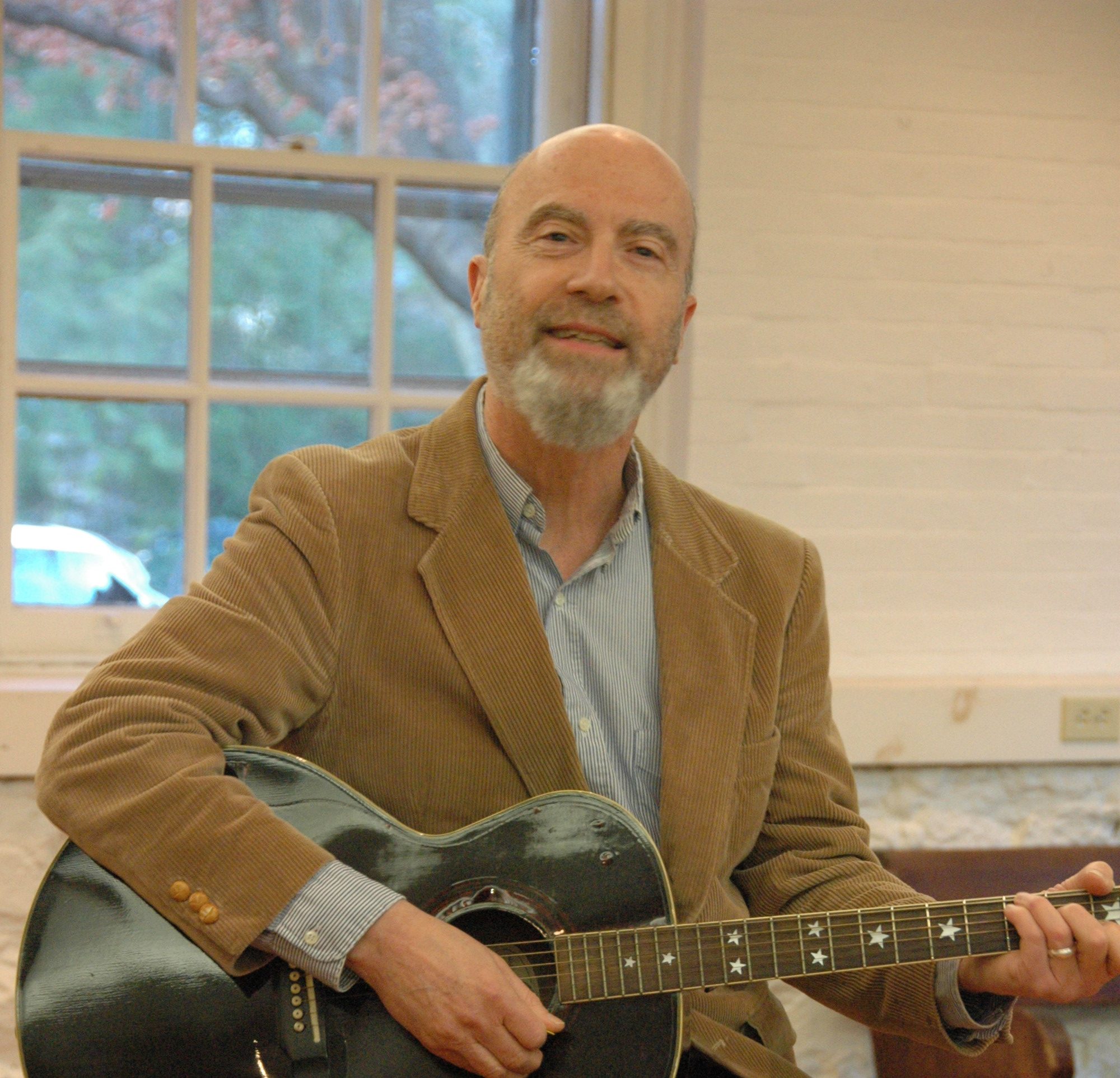
songs by Doug Gwyn
Home
“Seriously Funny”
Friends General Conference, QuakerBooks 2007
 The Brothers Doug