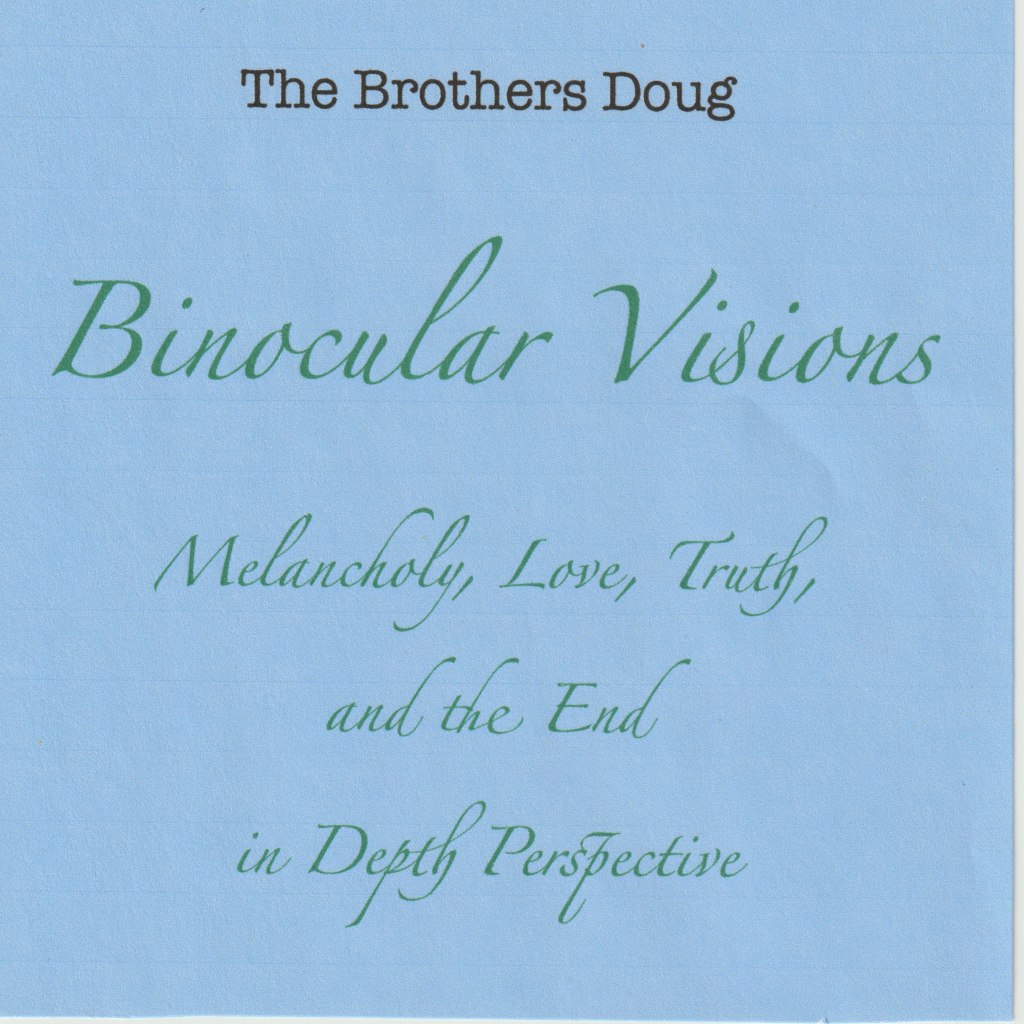
Binocular Visions offers double takes on melancholy, love, truth, and the end. That is, each pair of songs looks at the theme from two different angles. I didn’t plan it, but I noticed that I had done it with melancholy and then with love, so I decided to follow it through with truth and with the end
I finished this set of songs in June, but hesitated to launch it. Some of the songs seemed so dark. But now, in November 2024, they don’t seem too dark. So here goes —
“Melancholy” (February 2004) is surprisingly chipper, given its theme. I have always been melancholic, which definitely has moods of sadness, mourning, boredom, etc. But it also has a creative dynamic if I quit fighting and give in to it. Aristotle found some of the most creative people in the arts, literature, and politics to be melancholic personalities. This song borrows musically from the folk-song “I Wonder as I Wander,” surely the most melancholic of Christmas songs. But with the bouncy, Latin beat and vocal line, it’s hard to recognize.
Melancholy
“Blue Is the Color of Hope” (August 2018, re-recorded April 2024) has a gloomier feel. When I talked to my wife about these two songs, she replied, “”Hmmm — a happy song about melancholy and a sad song about hope.” I guess it’s just my ironic twist on life. When I began writing this song, I just had the title in mind. It played out as reflections on different colors and the moods we associate with them: blue, rosy, gray, red, green, yellow, and blank-and-white. The final verse moves into a meditation on the betrayal of Jesus. “Sweet vermouth” came to me as a surprise. The only times I ever tasted it were on some pastoral visits I paid to two elderly Italian Baptist sisters in the Catskills, in the early 1970s. They served me sweet vermouth. I liked the way the sweetness was balanced by the bitterness of the herbs that go into the fermentation process. This song resonates with “Blue” (2001) by Lucinda Williams, which begins, “Go find a jukebox and see what a quarter will do. I don’t wanna talk, I just wanna go back to blue.” Melancholy has been a powerful creative force in her song-writing over the years.
Blue Is the Color of Hope
“The City of Love” (March 2024), like many of my songs, began with just the title and seeing where it took me. Once again, irony rules. But it does seem that love is full of ironies, especially as you sustain it. Joys and sorrows, pleasures and pains, hopes and disappointments, spontaneity and patience intertwine endlessly. But you can get there and stay there, as you “sigh and follow the ache.”
The City of Love
“Can’t Kill This Love” (April 2024) complements “The City of Love.” I have to admit, the opening lines about murder jolt even me. But given the necrophilic culture around me today, I intuitively chose to explore love as its strongest counterpoint. The sustained piano figure, remaining the same through the chord changes on the organ, intends to evoke the persistence of “this love,” which to me is divine. But our human loves participate in it, if only imperfectly. We (the Brothers) invited our favorite girl-group, the Digitones, to be our angel choir.
Can’t Kill This Love
“Truth Decay” (January-February 2024) is a terrible pun. I blame T-Bone Burnett and his 1980 album by that title (I still have the LP!). And a warning: it’s not the only pun in the song. But it was my way into ruminating on the degrading effects of media hype, “alternative facts,” social media disinformation and vituperation, political polarization, and the triumph of the image over the word. I find myself singing with a different voice in different songs. In this one, I seem to be channeling Peter Lorre in Casablanca, or perhaps in The Maltese Falcon, where truth proves very hard to find amid a thicket of lies and bad intentions. Of course, “lies, damned lies, and statistics” is Mark Twain’s hierarchy of falsehoods.
Truth Decay
“The Frame” (April-May 2024) offers another take on the theme of truth. It explores how we “frame” the truth — and one another — according to various ideological suppositions and ego-investments. “Four corners form a frame, and every corner has an angle.” So the song suggests four angles in the frame we place around people and issues. The song holds out hope that we can transcend our frames — “get past ourselves,” as the preceding song suggests. The feedback in the instrumental interludes seems to suggest something — I’m not sure what.
The Frame
“Until” (December 2023) is a present-day meditation on Luke 17:22-37, where Jesus seems to be warning his people that life just seems to go along — until it doesn’t. I think he has in mind the catastrophic collision with Roman power that looms on the horizon at that time. He references life in the days of Noah and the fate of Sodom and Gomorrah. I update his saying, where it’s not rain or fire coming down from heaven, but our humanly contrived world raging on — until. The end of 2023 aroused these dark musings. 2024 has not allayed them.
Until
“Blessing and Curse Blues” (May 2024) reflects on the blessing and curse of human mortality, and the way “worlds always end.” In particular, it reflects on God’s description of the life Adam and Eve will lead after they have eaten the fruit of the knowledge of good and evil. God tells Adam that he will toil by the sweat of his brow until he returns to the ground from which he came (Genesis 3:19). Dietrich Bonhoeffer suggests that their (and our) sundered consciousness of good and evil, pleasure and pain, causes them (and us) to perceive God’s words as a curse. But it is equally a blessing, in that we don’t have to live this double-mindedness forever. As James Murphy of LCD Soundsystem puts it in “Tonite”(2017), “truth be told we all have the same end [it] could make you cry but i’m telling you: this is the best news yr gettin all week.” Musically, the Brothers again invited the Digitones, this time as backup singers.
Blessing and Curse Blues
I thought I had finished this collection with the preceding song. But then “Chiasmus-Callosum” occurred (June 2024). This song employs some brain science to put the “binocular visions” together. The optic chiasmus is an X-shaped set of nerves connecting the eyes with the vision centers in the back of the brain. It cross-references and integrates what the two eyes see. Meanwhile, the corpus callosum is a larger bundle of nerves between the two hemispheres that works to integrate what the left-brain and right-brain perceive and process. A brain scientist I read some years ago described the emergence of mind out of the processes of the brain as an “omega effect,” something that mysteriously draws brain processes to another level. That resonates with the theologian Wolfhart Pannenberg’s suggestion that the present is an effect of God’s ultimate future (omega) pulling us and everything toward ultimate unity. So I added one more unfamiliar word, katallagete, which means “be reconciled” in New Testament Greek. “We gotta gotta get together.” The driving R&B beat adds a certain compelling zest to the words, and puts a different spin on the preceding two songs on the End. So the song-cycle ends on a note similar to where it began.
Chiasmus-Callosum


Leave a comment