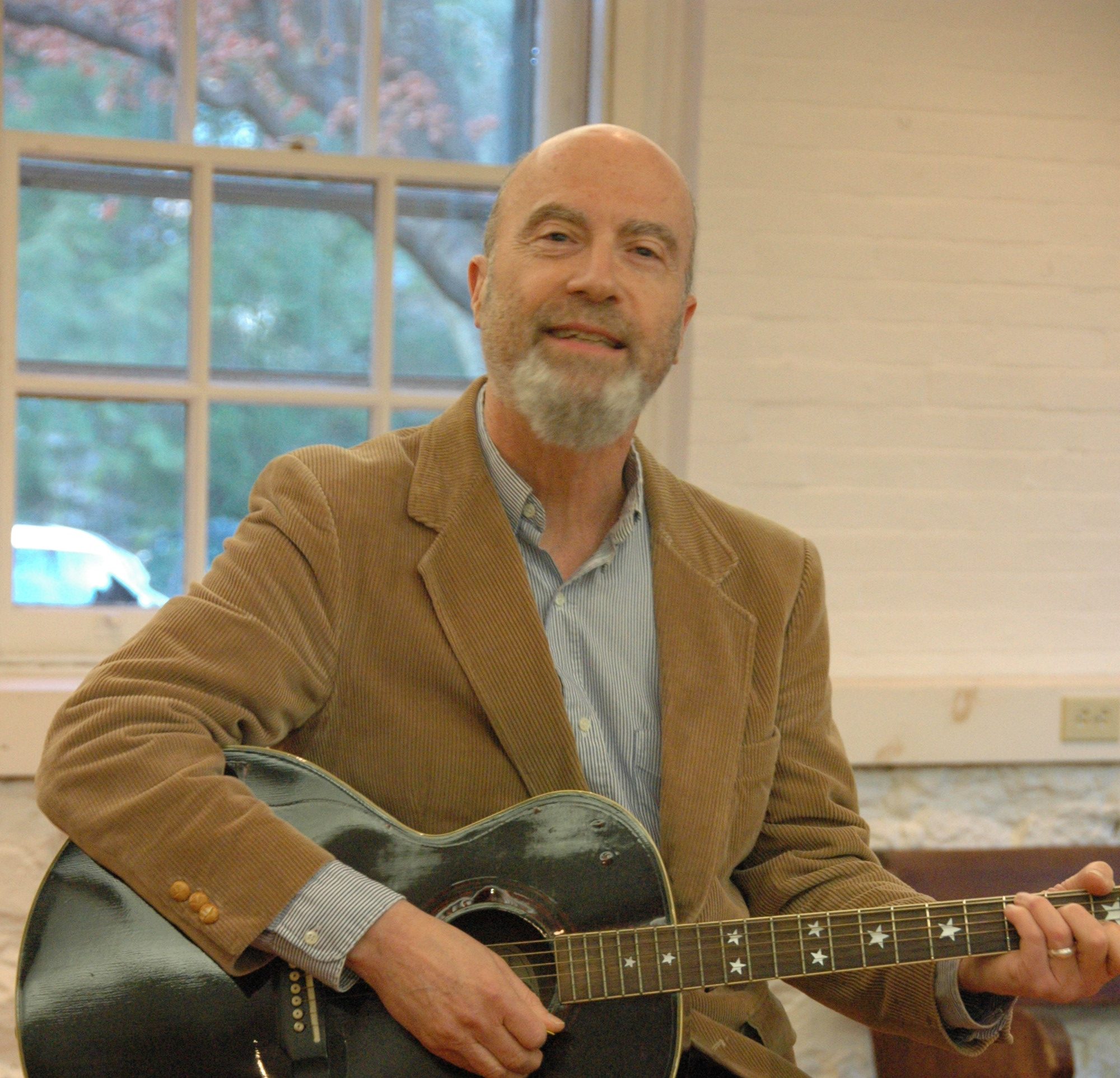
This collection of songs deals with the End, in various ways and senses of that word. As a student of theology I have long had an interest in eschatology, beliefs about endings, in world history and in personal history. The ancient Hebrew understanding of reality, as we find it in Hebrew and Christian Scriptures, is temporal. Truth is told in history and personal story — and ultimate truth is in the End.
But there are many endings in our personal lives that are not death (even if they may seem like it at the time). And there are endings in the wider world that are not annihilation of the universe, but the end of a certain world order. Current events, both political and environmental, feel like a world ending. But endings can open space for new beginnings. So I guess this collection has been provoked by current events, even if eschatology has been an important focus for me all along.
I’ve written books about eschatology in the Bible and in Quaker history (see my other website, douglasgwyn.life). But of course, the Brothers Doug “go there” in their own variety of ways. The lyrics to the following songs are at the bottom of this post.
“We Meet at the End of the World” (2025, from Post-Apocalyptic Debris and Points Beyond) is about seeing and moving beyond the present order, and meeting others there. I learned this from George Fox and early Quakers in 17th-century England. Their silent worship was the end of the world and the beginning of a new creation in personal and group experience. It led to path-breaking new insights and social formations. We can go there in various ways today.
“Let the Captives Go Free” (2014, from Death Warmed Over) looks at mass incarceration in the US today from the perspective of our warped consciousness of race and repressed consciousness of class. But still deeper is the “One we don’t know,” locked inside each of us, whom we are afraid to let free. The song draws upon James Cone’s book, the Cross and the Lynching Tree (2013), and a statement by George Fox about the mass incarceration of Quakers at the end of the English Commonwealth (1659).
“Seven-Sealed Scroll” (2020, from A Musical Personality Disorder) draws from the Book of Revelation, where only the Lamb (the risen Christ) is able to open a seven-sealed scroll that contains the destiny of the world. Christians have often interpreted this to mean a future, physical end of the world. But the violence, plagues, and injustices described with the breaking of the seals can be seen in any age. The vision is meant to end the world in our eyes and open our lives to a new creation. I wrote this song in the early months of the covid pandemic. It’s always intriguing to hear what voice comes forth with a particular song.
“Post-Apocalyptic Debris” (2025, from Post-Apocalyptic Debris and Points Beyond) looks at the end of the world not as an impending future but a present, unfolding disaster that began in the recent past. Musically, this song adapts a repeating figure from Isaac Hayes’ “Ike’s Rap II” (1971), which was sampled to good effect in the 1990s by British trip-hoppers Portishead and Tricky.
“Higher Ground” (2007, from Terms and Conditions) reworks and reconsiders an old revival hymn by the same title. It hovers somewhere between the twin crises of soaring national debt and accelerating climate change, both of them outworkings of our “besetting sin” of personal salvation, both religious and secular. Some of the observations feel more real now, as the world “gets a little bit hotter.” In the end, it poses the promise of “common ground” as the alternative to a personalized “higher ground.”
“Dreams and Visions” (2021, from The Last of the Brothers Doug?) was written while I was working through my dream journals from over the years. I also found some inspiration from James Hillman’s The Dream and the Underworld (1979). The song also draws from the book of Daniel, whose visions come in part through dreams of “the end.” It’s a rather grand production musically, inspired by listening to “Mauvais Sang,” a song by the Algerian rai singer, Khaled.
“New Pair of Glasses” (2009, from Terms and Conditions, re-recorded 2026) unfolds from the simple premise of seeing the world with new eyes, ending one’s former perceptions and participation. “The earth burning up” seems a lot more real in 2026, but you could see it coming clearly enough in 2009. And the “endless wars” in Afghanistan and Iraq at that time were also on my heart. The kingdom and its king get a twist at the end, owing in part to the musical inspiration for this song, the traditional blues-folk, “Motherless Children.”
“She Keeps Calling Me” (2021, from The Last of the Brothers Doug?) is another song inspired by my dream journals. It’s indirectly a composite of three dreams, two from the recent past and one from my teens. Like some other songs from that collection, it confronts my mortality. In this case, it explores that alluring but uneasy realm of eros and thanatos, love and death. Musically, it approximates something I heard in that teenage dream.
“Disorient Express” (2009, from The Political Unconscious, re-recorded 2026) is a train song. But as the title suggests, this is a different kind of train, where the world does all the moving. Stillness, the end, is at every point along the way.
“Blessing and Curse Blues” (2024, from Binocular Visions) looks at personal endings and then world endings, affirming the blessing and curse in each. Embracing the tragic instead of the “magic” of denial allows one to see that “worlds always end.” The Digitones, our favorite girl-group helped out with this song.
Finally, “Parallax Vision” (2026, from Parallax Vision) adds one more angle to this collection. The song is about transcendence, which is one aspect of the End, the end of our fixed, subjective viewpoints. The song combines parallax and paradox in various ways. Finally, “to see as God sees you brings the common into view, in parallax vision.”


Leave a Reply