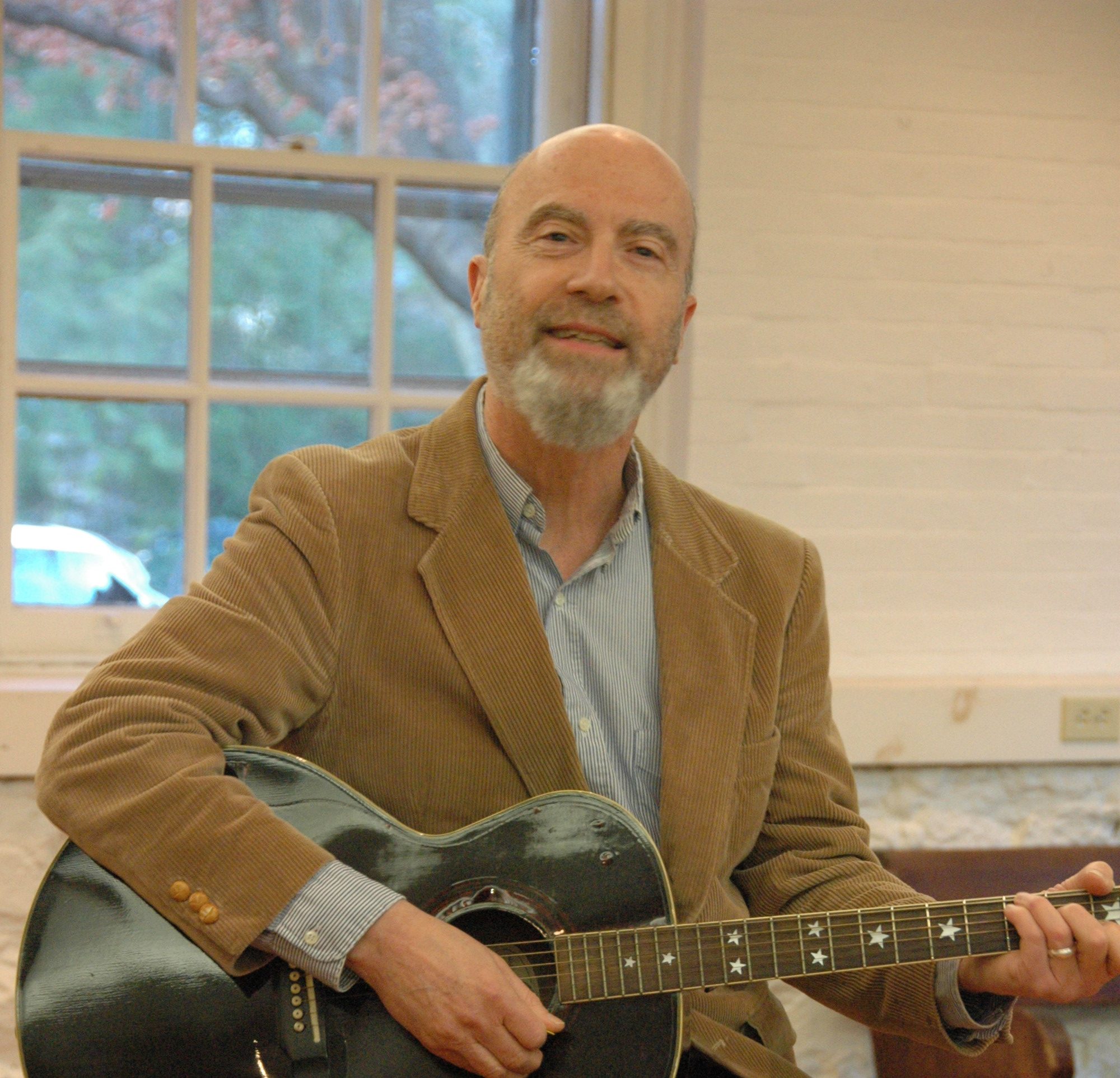
Many of my songs over the years have worked with issues of spiritual captivity versus transcendence. This is a collection of some of those songs, under the rubric of “parallax vision.”
Parallax is the difference in viewpoints, where the same object is viewed from different subjective places. But even as each of us sees the object differently, we are all participating in the same reality. There is a gap, a void between us as subjects. But we can find ourselves in the same picture, beyond our subjectivities, and beyond the objects we perceive.
Thus, there is some form of transcendence implicit in parallax vision, not only a transcendence of the self in relation to another self’s point of view, but also in relation to the object viewed. There is a common reality in which we participate together, “visible” from a transcendent One.
Of course, that One is understood and named differently from our different places in the common reality. The Apostle Paul gave it one powerful expression: “There is no longer Jew or Greek, there is no longer slave or free, there is no longer male and female; for all of you are one in Christ Jesus” (Galatians3:28). This is no easy assertion of universality. Our common reality in the One comes by way of a negative moment, figured by the cross and resurrection of Jesus. The gaps between us remain, and can still be troubling, but we can also see ourselves in the One picture. (I’m adapting here some things I’ve learned from Slavoj Zizek’s The Parallax View, 2006).
I am particularly interested in that ultimate transcendence, and how it reframes our lives and relationships. So these songs are organized in pairs, alternating between the various ways we are held captive by our points of view in the modern world, and the various ways we may experience transcendence, within the ultimate horizon of God’s loving gaze. “Seeing as God sees you brings the common into view” (at the end of the first song). So let’s begin. (All the song lyrics are in a file at the end.)
“Parallax Vision” (2026) begins this collection by introducing the concept that will play out in the ensuing pairs of songs. I’ve already made that introduction in the preceding paragraphs, but the song finds its own way of expressing it.
“Mirror Image” (2025, from Tales from the Grift: The First One Hundred Days) was written and recorded during the first weeks of Donald Trump’s second Presidency. The song draws from the Greek myth of Narcissus and Echo to reflect on the dynamics of Trump’s narcissistic personality, and how he and his strategists built a winning electoral strategy by mirroring the same narcissistic impulses in the American electorate. This is the opposite of transcendence, as it keeps redoubling upon itself into a tighter and more deranged politic.
“These United States of Grace” (2017, from Man of Irony, re-recorded 2026) offers a transcendent perspective. A United States of Grace is an undefined polity of all kinds of people “from every faith and place and race.” You could call it interfaith or multicultural, but these are largely humanistic, secularized frames. “Grace,” is what happens through and beyond us as “let our lives entwine and interlace.” It is a continuous process by which “the fabric of society is stitched again, quietly.” This happens beyond the vision or intention of any of us, as we move “in patterns even we don’t know.” Self-consciously social and political movements remain vital, but these united states of grace underlie and underpin them.
These United States of Grace
“Slippery Slopes (Two Poles in Polar Vortex)” (2024, from Caveats and Credos) is closely related to “Mirror Image,” and was written shortly after the 2024 elections. The polarization of American politics and society grows as we harbor our worst suspicions about the tendencies of one another’s beliefs, values, and activities. It’s not just what they’re doing, but where they’re tending — down a slippery slope! That suspicion pushes me further along my own slippery slope, a polar opposite, an inverse position, which becomes a vortex in its own right. At the end, the song resorts to “marriage” as an idiom of covenant relationship to suggest the way out of our mutual vortices. But . . .
“The Sign of Jonah” (2023, from DougBurger Deluxe: Rare Songs Done Medium-Well) harkens to Jesus’ comment that the only sign his generation would receive was the sign of Jonah: “Repent!” Jonah was enraged that God chose to spare the hated Assyrian city of Nineveh. Each verse of this song begins with a paraphrase of Psalm 2:1 (“Why do the peoples rage?”) The song ponders the relentless cycles of rage and violence that wrack human societies. But it points to a way out.
“The Parlor of No Return” (2013, from A Musical Personality Disorder) sounds at first a dig at religion and then a dig at liberal humanism. But it’s really about “the discreet charm of the middle class,” a vast plane that domesticates and norms all things in American life into a parlor conversation. The middle class is “a mystification so deep and vast” that it loses a larger frame of reference. As a self-referencing arbiter of what is “good,” it loses transcendence. And God had better be “good,” or who needs “Him?” As a middle-class drop-out who can still “pass” most of the time, I find the parlor conversation both comforting and maddening. At the end, there’s an echo of John Lennon’s “Working-Class Hero,” reframed.
“The Good Is a Merciless God” (2021, from Every Doug Agrees) blends a couple conversations of Jesus, with a rich man and with a scribe. When Jesus is addressed as “good teacher,” he answers, “Why do you call me good? No one is good but God alone” (Mark 10:18). This song follows the preceding one, pondering good versus God. Musically, it follows the chord progression of Bob Dylan’s “Gates of Eden” (1965), which has a similar message, set in imagistic poetry.
“Miss Information” (2020, from Every Doug Agrees, re-recorded 2026) portrays how the internet (remember the utopian “Information Highway” of the 1990s?) narrows our attention into a never-ending informational quest, by way of a small screen, bracketing bigger questions and wider perspectives. Here, information is portrayed as a goddess crossed with a beauty queen, teasing and alluring us on. The song is playful but serious. In part, it is a meditation on Jacques Ellul’s penetrating insight that technology is a means that imposes its own ends. And at some point, Miss Information becomes misinformation.
“Shekinah!” (2020, from A Musical Personality Disorder) answers “Miss Information” with the feminine Hebrew name for God as divine Presence or Light. The song expresses something of my own life experience, in elliptical terms. The final verse reflects on how, in the present “gilded age,” Shekinah escapes the “gilded cage” of institutional religion, to fly free above the “raging sea” of secular culture.
“O Commodity!” (2025, from Post-Apocalyptic Debris) is an odious ode to the commodity, the image, and the spectacle. These are three ways our consciousness is blinkered, our point of view becomes fixed, in today’s culture. These fixations occlude the larger realities of the picture we are part of. But at the end, the song suggests there is “a still, small voice, from beyond consumer choice.”
“The Blues of Heaven” (2016, from Man of Irony) follows, reflecting how “in the realm of delusion, things may appear like magic, then turn out a lot more like tragic.” Troubles often open out our hearts and minds to the larger reality. And the blues are a powerful expression of the African American experience. The song mentions Yank Rachell and Sleepy John Estes, who opened the world of the blues to me, while I was college student and organizing concerts that featured them. The song opens out to the ultimate horizon, the blues of heaven (which I may have heard one night in 1989, lying in Intensive Care). The “still small voice” from the preceding song returns here as a “deep, pentatonic hush.”
“Liberate the Corporation Now! (2016, from Man of Irony, re-recorded 2026) takes on another powerful bracketing of reality in the stock-holding corporation. The song was provoked in part by the egregious Supreme Court decision, Citizens United v. Federal Election Commission (2010), which ruled that as legal “persons,” corporations have the right to make unlimited political contributions under the First Amendment. From a very different perspective, the Quaker organizational consultant Robert Greenleaf (best known for his 1977 book, Servant Leadership), once commented that the stock-holding corporation is “chattel.” He didn’t elaborate, but his comment stirred my thinking in new ways. It eventually inspired this song, each verse of which offers a different perspective on the corporation as “person.”
“An Epiphany Waiting to Happen” (2011, from Terms and Conditions, re-recorded 2026) addresses our human condition in extremis, and invites us to “turn around and see me.” The inspiration started from Bob Dylan’s “Queen Jane, Approximately” (1965), but quickly took on a life of its own.
We finish with a pair of songs that sums up the dynamics of parallax vision.
“The Bell Jar” (2024, from Caveats and Credos) was probably provoked by that year’s election campaign, along with many other global events. The world — climate, war, and politics — feels increasingly suffocating. As the last verse indicates, the song draws upon Sylvia Plath’s semi-autobiographical novel, The Bell Jar (1963). Her proto-feminist imagery evokes what I’m sensing on a global scale. Can we transcend?
“I Don’t Really Exist” (2003, from The Best of Chronicles of Babylon, re-recorded 2026) came to me from listening to the growing number of nontheist Quakers while I was teaching in England. I found an admirable integrity among most of them, but they also held caricatured views of God and religion in many cases. I wrote this song to extend myself as far as I could toward their point of view. The result is a wry parallax. Not long after I wrote the song, I came across a Kierkegaard quotation that epitomizes the matter beautifully: “God does not exist, God is eternal.”


Leave a Reply