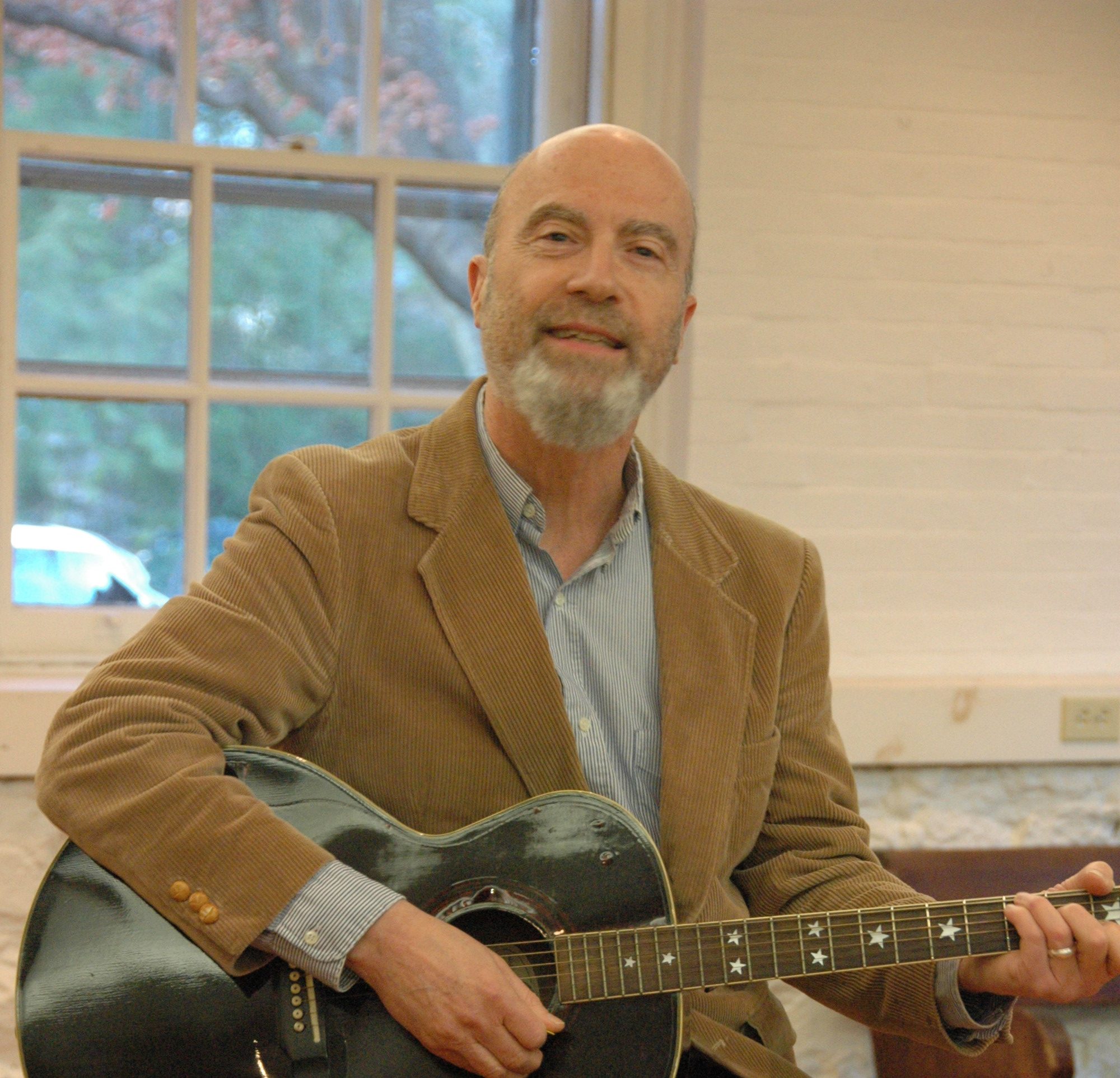
It occurs to me that a number of my songs from over the years could be arranged as an autobiography of a sort. I’m calling it a musical because they are songs. The introductions that accompany the recordings below serve as the spoken parts of a musical, or the recitative of an oratorio. But “oratorio” sounds a bit grand for “The Life of Doug” and the music of the Brothers Doug.
As always with my songs, you will find irony where you might expect more forthright expression of healthy emotion. I have no problem with the latter, but it doesn’t seem to work out that way with me. Perhaps my long series of childhood illnesses produced a cleft in my personality. Irony generates multiple possibilities and levels of meaning, which can make the songs amusing, confusing, or sometimes troubling. But it leaves more for the listener to work with. Anyway, that’s how it is for the Brothers Doug.
My song-writing was pretty sporadic while I was still working. So this collection is weighted more toward my life’s middle and later years. But there are so many songs of youth out there. I feel affinity with the later work of Leonard Cohen (Ten New Songs, 2000), Bob Dylan (Time out of Mind, 1997), and Gillian Welch-David Rawlings (Woodland, 2024).
Lyrics to the songs are in a file at the bottom of this page.
So, here goes:
“Who Put the F in Ineffable?” (2023, from Doug-Burger Deluxe) plays with an old rabbinic legend that explains why each of us has that little indentation between the upper lip and the nose. It is said that the Archangel Michael touches his finger on the lips of each baby just before birth, to keep it from divulging the secrets of the universe. Musically, the song took form on its own as a light, playful ditty.
“The Dude” (2017, from Man of Irony) was my childhood nickname, as the song explains. This loping, reggae-ish tune describes me in those early years. “Was he a mystic or a space cadet, the way he looked right through that TV set?” It describes the “chimp-like attitude” I exuded much of the time, as a reasonably happy child. The evident sadness of the song’s tone seems to imply something else, but I’m not sure just what. Maybe it’s about lost innocence:

The Dude
“Existential Shoes” (2011, from Terms and Conditions, re-recorded 2026) moves into adolescent angst. I found adolescence confusing and troubling, for sure. But while others were acting out, I acted in, which isn’t necessarily better. In any case, this song comes from many years later, indicating that the shoes are still “way too tight.” Maybe others can relate.
Existential Shoes
“Mall Story” (1990, from The Best of Chronicles of Babylon, re-recorded 2026) leads on to romance. But here it’s romance mediated by consumer preferences. In 1958, when I was nine, my family moved to a new home on the north side of Indianapolis, just two blocks from a new shopping mall, where I spent a lot of time. That must have some bearing here. The fifties doo-wop style of the song fits. This song was inspired in 1990 as I watch how TV ads mix romantic themes and images with consumer products. The song’s refrain advises the love-lorn, “No, you can’t buy love, but if you love to buy, fall in love with the one who buys the things you love.”
Mall Story
“That of Odd in Every One” (2014, from The Political Unconscious) is a play on the Quaker conviction of “that of God in every one.” It suggests that “oddliness and godliness can intertwine, ’cause odd, like God, means one of a kind.” It’s a process of individuation for each of us, if we’re willing to go there. In my own case, I think by the time I was forty, I began to realize and accept that my own oddliness was well underway and still unfolding.
That of Odd in Every One”
“Hair Envy” (1997, from The Best of Chronicles of Babylon, re-recorded 2026). My mother had a lot of bald uncles, so my brother and I saw our destiny from an early age. This song is about enjoying other peoples’ hair — “there, where I can see it.”

Hair Envy
“Am I Tragic Yet?” (2002, from Death Warmed Over) arose from those “long strange years of middle age” when you begin to wonder if you’ve lost the plot somewhere along the line. This song teeters between self-pity and self-mockery, asking “Am I tragic yet, or is there still more to regret? Will I grow wise or just learn to forget?” It was inspired partly from study of ancient Greek tragedy and connects to “That of Odd in Everyone,” that place where (like Oedipus) “your genius meets your tragic flaw.”
Am I Tragic Yet?
“Gravity” (2012, from Terms and Conditions, re-recorded 2026) gets further into aging. “Gravity keeps pulling me down . . . gravity’s the pull of the grave.” Life’s years and losses accumulate as “gravitas, which hangs from me like Spanish moss, gray as a November day.” But it’s also affirmative. After all, “I’m not aiming for the Smithsonian.”
Gravity
“Baby, I’m Retired!” (2019, from Moments of Truth) mixes relief from the world of work with a sense of being left behind by “the cybernetic rapture,” as well as forebodings of old age. Musically, it was inspired by an old Kinks song from the 1960s, “Look for Me, Baby.” Finally, I conclude, “I guess it’s time to take my rest, I wish you all the very best, Baby, I’m retired!”
Baby, I’m Retired!
“Growing Old Absurd” (2023, from Doug-Burger Deluxe) picks up further on into retirement. It was inspired in part by Paul Goodman’s book, Growing Up Absurd (1960), where he suggested that various forms of youth rebellion in the latter 1950s were the result of young people unable or unwilling to fit into a post-war society of consumerism, superficial religion, depersonalizing bureaucracy, and so on. Goodman’s book helped spark the more rebellious 1960s. This song takes shape from the other end of the life-cycle, where “an uncle without a cause” like myself feels irrelevant and absurd, while techno-capitalist society rages on, “helter-skelter, I believe is the word.”
Growing Old Absurd
“Time Is like Wine” (2005, from The Best of Chronicles of Babylon, re-recorded 2026) plays out an idea I have had for some time, that senility in old-age is becoming drunk with time. The verses proceed from the slow sips of youth, when “eternity kisses each day,” through adulthood with “the gathering haze of so many days,” and into old age, when “sorrows are nearly all drowned.” The song was inspired in part by watching my mother’s advance into dementia. In the end, the song’s melancholy manages to affirm, “eternity’s there in the time that you spare to drink of me today.”
Time Is like Wine
“Down the Hall” (2021, from The Last of the Brothers Doug?) is “a little stroll down the long hall of recall,” a life-review of people and places, allies and nemeses. “I’ve got to thank or forgive ’em all.” Looking further down the hall, I see “no floor, no ceiling, no walls,” but “I can’t stop now.”
Down the Hall
Finally, “Lost at Last” (2023, from Doug-Burger Deluxe) looks back at life from Jordan’s banks, with “some regrets but mainly thanks.” Just “lay me down on common ground” somewhere. I’m “lost at last in You.”
Lost at Last
 The Brothers Doug
Leave a comment