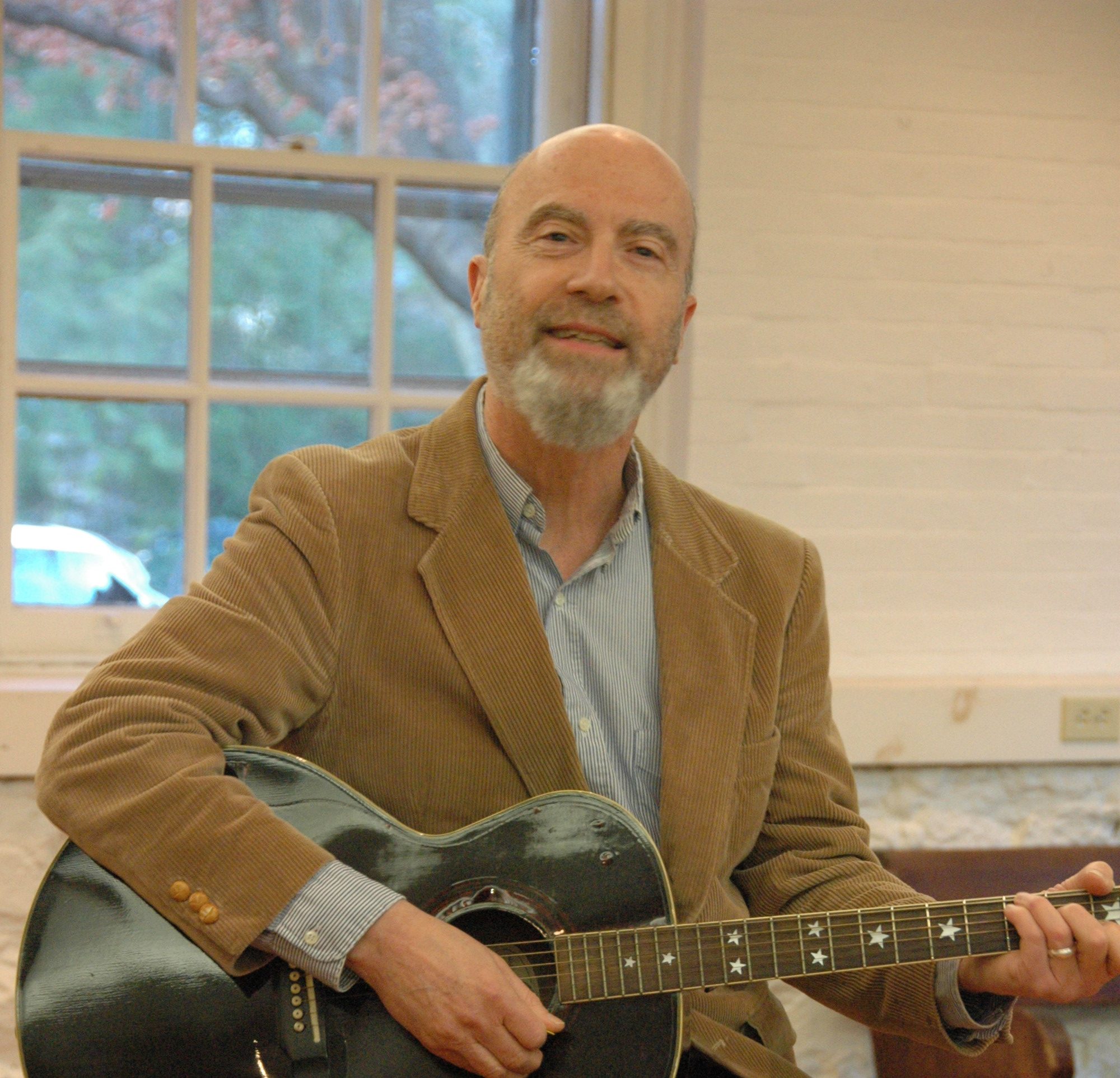
This collection is a song-cycle that alternates between less hopeful and more hopeful songs. I regret that the unfolding disaster of Trump II has made the new songs the less hopeful ones. I had to dig back a few years to find more hopeful ones to intersperse and interact with them. But that has been a useful exercise and an encouraging one, at least to me with my irenic but ironic sensibilities.
“Post-Apocalyptic Debris” (November 2025) opens this collection, suggesting that the apocalypse “came and went, and we missed it.” Musically, this song adapts the repeating figure from Isaac Hayes’ “Ike’s Rap II” (1971), which was sampled to good effect in the 1990s by British trip-hoppers Portishead and Tricky.
Post-Apocalyptic Debris
“Multitude” (2019, from Moments of Truth) summons a completely different, almost strident tone. I follow the work of Michael Hardt and Antonio Negri in finding multitude — from the 117 million refugees and internally displaced persons world-wide to the flux of precarious labor in post-industrial society — to be the antipode to today’s global capitalist empire. They/we are part of the post-apocalyptic debris. But like the multitudes that followed Moses into exodus and the multitudes that flowed around Jesus, today’s global multitude can move in either revolutionary or reactionary directions. Hardt and Negri suggest that common wealth may yet form out of the mix-and-match flows of today’s multitude. But to those at the commanding heights of today’s regime, the multitude is a “many-headed hydra, monster from the deep.”
Multitude
We Meet at the End of the World (October 2025) offers the up-beat suggestion that “you can always change your mind and meet us at the end of the world.” Any point beyond today’s debris is found where we see and connect beyond the world as we know and participate in it, and beyond ourselves as we know ourselves.
We Meet at the End of the World
“Common as Dirt” (2018, from Moments of Truth) is a seriously whimsical meditation on Adam and Eve in the garden, naked and common as dirt (the literal name of Adam). But we like they cover ourselves with “fig-leaf excuses,” and have forgotten and repressed that truth. This is one of many songs I’ve written trying to define or evoke what the common life means.
Common as Dirt
“O Commodity” (December 2025) is an ode of sorts — an odious ode. It offers ironic praise to commodities, images, and spectacles. These are major ways our common background in the dirt gets hidden. The words draw on Karl Marx’s analysis of the commodity, Guy Debord’s critique of the spectacular society, and Jacques Ellul’s insights into the ways visual images deafen us to the living Word today. But some of us still hear it, “in a background we can barely feel.”
O Commodity!
“All Life is Human Life” (2019, from Moments of Truth) presses on from “Common as Dirt,” to emphasize that all life is human life in that it comes from and returns to the earth (humous). Thus, our life is in common with all plants, animals, bacteria and the earth itself. It’s not too late to “come down from that digital tower.” The song is a bit “hee-haw,” but that seems appropriate.
All Life is Human Life
“Puppets” (December 2025) investigates the hidden hands and invisible wires that manipulate human behavior and shape society, “entertaining and maintaining the illusions of a world.” The New Testament calls these hidden forces “principalities and powers.” Today’s rampant conspiracy theories are only crude approximations of the deeper spiritual forces at work in every society and every age. The song was provoked partly by today’s unprecedented proliferation of all kinds of films and television series, fueled by the streaming industry and our withdrawal into endless fantasy worlds at home. But there is one who abides amidst all this narrative pollution, and can “cut invisible wires.”
Puppets
“The Foot of the Cross” (2015, from A Musical Personality Disorder, 2020) picks up from the end of “Puppets” to express the vantage point on the world and oneself that comes from standing at the foot of the cross, beginning to see what Jesus sees, and acting accordingly. And amid “the ruin of great nations and the groaning of creation, there’s a glimmer of salvation.”
The Foot of the Cross
“Apex Creditor” (October 2025) was provoked by hearing how deeply indebted the US has become, a process which began to accelerate with the Reagan tax cuts and is now in hyperspace with the Trump tax cuts. It’s “a whole economy on Social Security.” I’m no expert, but $38 trillion of debt, with the federal government paying $100 billion per month just to service that debt, seems like a problem. “Apex creditor smells blood below the waterline.”
Apex Creditor
“In the Flow” (2008, from A Musical Personality Disorder, 2020) is a phrase I know from basketball, that most spiritual of sports (at least to a Hoosier like myself). But it also evokes something of the spiritual experience others might recognize as well. The song flows from the Holy Ghost, through the Alpha and Omega, with a passing nod to Arthur Rimbaud, on to the Lamb and the heavenly Jerusalem, “a riddle in the middle of this great big mess,” where “the river of life flows through the center, none but the pure in heart can enter, good God, we’re in the flow.”
In the Flow
“A-I-A-I-Oh! (Open AI Has a Farm)” (November 2025) is what it is. It follows in the dissenting tradition of Bob Dylan’s “Maggie’s Farm” (1965) and the Bently Boys’ “Penny’s Farm” (1929). But this farm is enclosing all of us, faster by the day. I just hope old MacDonald doesn’t sue me for this.
A-I-A-I-Oh!
“Dark Matter/Dark Energy” (2019, from Moments of Truth) is a playful mix of astrophysics and theology. Modern physics suggest that over 90% of the universe is made up of “dark” matter and energy, undetected by existing instruments. Only this overwhelming preponderance of unseen matter and energy can account for the gravitational dynamics that hold galaxies together and make them spin. This undetected realm is where “we live and move and have our being,” to use the phrase of the ancient Stoic philosophers, which the apostle Paul borrowed when visiting Athens (according to Acts 17). While dark matter/energy exerts a gravitational force visible on the scale of galaxies, its influence extends down to smaller scales. This song suggests that it may be what Paul in Galatians 5 calls the fruit of the Spirit, drawing and holding humans together wherever we attune ourselves to it. This song is neither astrophysics nor metaphysics, but a suggestive analogy. Musically, the song was inspired by “White Heat/White Light” by the Velvet Underground (1968). But while theirs is an ode to amphetamines, mine aims much higher. It suggests that, notwithstanding our post-apocalyptic debris, there is a force that can still draw us together into a coherent common life, if we move with it.
Dark Matter/Dark Energy
 The Brothers Doug
Leave a comment